
AI Analytics Designed Specifically for Packaging & Bottling Operations
Packaging and bottling operations are among the most automated, throughput-intensive, and quality-controlled environments within the Food & Beverage Manufacturing Industry. Every production shift depends on synchronized operation of bottle depalletizers, bottle unscramblers, rinsers, rotary fillers, monoblock filling systems, aseptic fillers, capping machines, induction sealers, shrink sleeve applicators, pressure-sensitive labelers, inkjet coding systems, laser marking equipment, vision inspection systems, checkweighers, case packers, robotic palletizers, automated warehouse systems, cold storage facilities, and beverage distribution centers.
Maintaining consistent production performance requires significantly more than equipment automation. Packaging operations rely on accurate identification of products, packaging materials, pallets, returnable transport items (RTIs), mobile assets, workforce movement, warehouse inventory, and finished goods throughout production and distribution. Every operational event contributes to packaging efficiency, product quality, food safety compliance, warehouse execution, and customer fulfillment.
AI of Things (AIoT), commonly referred to as AI and IoT, combines AI with connected industrial identification devices, enterprise software, wireless communications, and operational data to improve manufacturing decision-making. Depending on operational requirements, AIoT solutions may incorporate Industrial AI, Edge AI, machine learning, computer vision, and Physical AI while maintaining a strong emphasis on identification and location technologies rather than conventional sensing systems.
Within packaging and bottling facilities, AI continuously evaluates identification events collected from RFID readers, BLE infrastructure, UWB positioning systems, industrial barcode scanners, GS1 DataMatrix labels, SSCC pallet labels, EPCIS event repositories, warehouse management software, Manufacturing Execution Systems (MES), Enterprise Resource Planning (ERP) systems, Warehouse Management Systems (WMS), Wi-Fi, Private LTE, and Private 5G communications. Rather than generating static production reports, AI transforms these operational events into actionable analytics that support workforce optimization, packaging asset visibility, warehouse execution, inventory planning, work-in-progress management, bottle serialization, lot genealogy, and production decision support.
The result is improved operational visibility across filling lines, labeling operations, packaging cells, palletizing systems, warehouse logistics, refrigerated storage, and outbound distribution while maintaining regulatory compliance, product quality, and manufacturing efficiency.
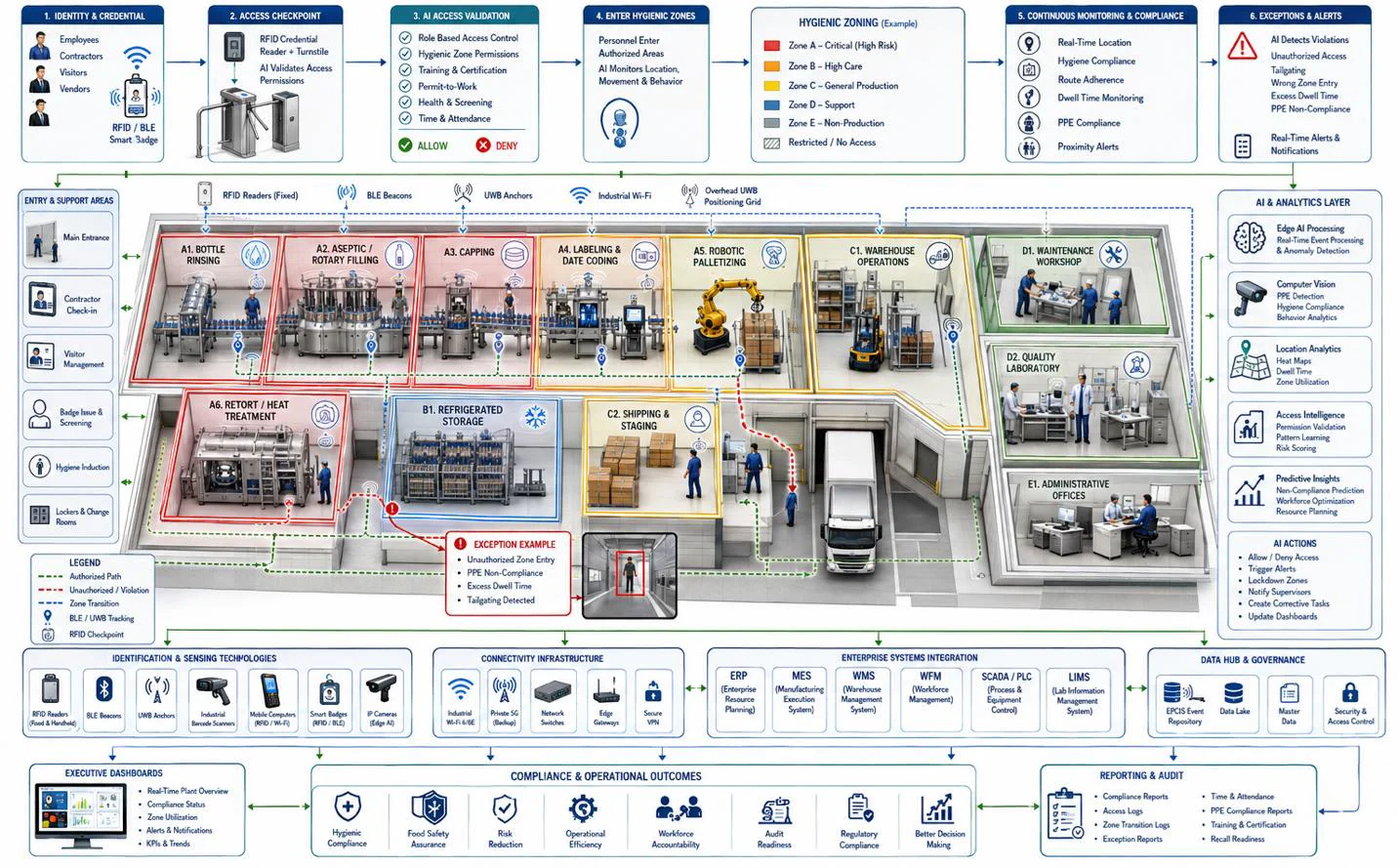
AI-Assisted Hygienic Access Compliance Workflow for Beverage Packaging Facilities
This workflow diagram demonstrates how AI, RFID, BLE, and UWB technologies enable hygienic access compliance across a modern beverage packaging and bottling facility. It illustrates employee credential validation, controlled entry into production zones, real-time personnel monitoring, exception detection, and integration with Edge AI, ERP, MES, workforce management systems, and executive dashboards to improve food safety, regulatory compliance, workforce accountability, and operational efficiency.
Packaging Workforce Analytics
High-speed packaging and bottling operations depend upon coordinated interaction between production operators, filling technicians, packaging specialists, warehouse personnel, sanitation crews, maintenance engineers, quality assurance inspectors, automation engineers, utilities personnel, and logistics teams. Even highly automated facilities require continuous workforce coordination to maintain production efficiency, product quality, food safety, and regulatory compliance.
AI workforce analytics transform identification and location events into operational insights that help production managers understand workforce movement, optimize staffing levels, improve labor allocation, strengthen workplace safety, and reduce production delays. Rather than relying on manual observations or end-of-shift reports, AI continuously evaluates workforce activity to identify recurring operational patterns, congestion areas, excessive travel distances, delayed responses, and workflow inefficiencies.
Packaging Line Personnel Location Analytics
Packaging personnel routinely move between filling equipment, labeling stations, palletizing cells, warehouse staging areas, maintenance workshops, quality laboratories, packaging material storage locations, sanitation stations, utilities rooms, and finished goods warehouses.
AI analyzes workforce movement to identify:
- Excessive travel distances
- Congestion around filling lines
- Delayed operator response
- Material replenishment delays
- Production support inefficiencies
- Warehouse coordination issues
- Shift staffing imbalances
- Underutilized labor resources
- Packaging line support frequency
- Cross-functional workflow interruptions
These insights enable production managers to optimize staffing assignments, improve production scheduling, reduce unnecessary workforce movement, and increase overall packaging efficiency.
Bottling Crew Movement Analytics
Successful bottling operations require close coordination among filling operators, maintenance technicians, sanitation teams, warehouse personnel, quality inspectors, automation specialists, packaging supervisors, and logistics coordinators.
AI continuously evaluates crew movement patterns throughout production shifts to identify:
- Maintenance response efficiency
- Packaging line support frequency
- Changeover staffing effectiveness
- Material delivery coordination
- Warehouse replenishment timing
- Production support allocation
- Cleaning schedule adherence
- Cross-shift operational consistency
- Workforce collaboration trends
- Production resource utilization
Historical trend analysis supports continuous improvement initiatives while minimizing production interruptions and improving labor productivity.
Filling Operator Lone Worker Analytics
Maintenance technicians, sanitation personnel, warehouse operators, and filling technicians occasionally perform independent work within refrigeration rooms, utilities spaces, elevated conveyor systems, warehouse aisles, CIP equipment rooms, packaging utility corridors, and isolated production areas.
AI evaluates identification and location events to recognize situations where personnel remain alone beyond expected operating procedures. Supervisors receive improved operational visibility that supports workforce coordination, work verification, emergency preparedness, and established workplace safety practices while maintaining uninterrupted production activities.
The solution emphasizes industrial identification and location technologies instead of conventional sensing systems, making it well suited for regulated food and beverage manufacturing environments.
Packaging Shift Workforce Flow Analytics
Packaging facilities experience significant workforce movement during production startup, product changeovers, sanitation windows, preventive maintenance activities, packaging material replenishment, warehouse restocking, finished goods staging, shipping preparation, and shift transitions.
AI continuously evaluates workforce flow throughout these operational phases to identify:
- Congested production areas
- Inefficient travel routes
- Labor concentration
- Packaging line coordination delays
- Warehouse traffic patterns
- Material handling inefficiencies
- Shift transition performance
- Changeover staffing opportunities
- Production support effectiveness
- Workflow optimization opportunities
These operational insights enable engineering managers and production supervisors to redesign workflows, optimize labor allocation, improve scheduling, and support continuous operational improvement while maintaining food safety and hygienic production requirements.
Bottling Access Compliance
Food and beverage packaging facilities operate under stringent food safety, product quality, hygienic manufacturing, and regulatory compliance requirements. Personnel movement throughout production areas must be carefully controlled to minimize contamination risks, maintain product integrity, and support compliance with Good Manufacturing Practices (GMP), Hazard Analysis and Critical Control Points (HACCP), Food Safety Modernization Act (FSMA), ISO 22000, BRCGS Global Food Safety Standard, Safe Quality Food (SQF), and internal quality management procedures.
Unlike conventional badge access systems that simply authorize entry, AI-assisted access compliance continuously analyzes identification and location events to understand workforce movement patterns, identify operational anomalies, strengthen hygienic zoning, improve workforce allocation, and provide actionable operational insights without interrupting production.
Using RFID employee credentials, BLE identification devices, UWB positioning, industrial barcode identification, mobile RFID readers, and enterprise access management software, AI creates a comprehensive operational view of authorized personnel movement across production, warehousing, maintenance, quality assurance, utilities, and logistics operations.
Hygienic Filling Zone Access Analytics
Hygienic production areas require controlled personnel access to protect beverage quality and reduce contamination risks throughout filling and packaging operations.
AI continuously analyzes identification events entering controlled production environments such as:
- Aseptic filling suites
- High-care packaging rooms
- Bottle rinsing stations
- Rotary filling lines
- Monoblock filling systems
- Beverage blending areas
- Syrup preparation rooms
- Clean-In-Place (CIP) equipment rooms
- Sterile packaging zones
- Product contact equipment areas
Operational analytics identify:
- Unexpected personnel movement
- Unauthorized zone transitions
- Excessive traffic within hygienic areas
- Contractor activity
- Shift-specific access trends
- Maintenance scheduling conflicts
- Cleaning crew coordination
- Workforce utilization during sanitation periods
- Production support frequency
- Temporary access exceptions
These operational insights strengthen hygienic manufacturing practices while improving production coordination and supporting food safety compliance.
Bottling Line Access Verification
Modern packaging lines contain numerous production cells where personnel require different authorization levels depending upon operational responsibilities, production schedules, maintenance activities, and quality assurance procedures.
AI continuously evaluates identification events across:
- Rotary fillers
- Monoblock fillers
- Bottle conveyors
- Cap feeding systems
- Closure inspection stations
- Induction sealing equipment
- Labeling machines
- Laser coding stations
- Inkjet coding equipment
- Vision inspection systems
- Checkweighers
- Case packers
- Robotic palletizers
- Automated warehouse interfaces
Instead of replacing existing access management software, AI improves operational visibility by recognizing recurring access patterns, identifying unusual production activities, reducing manual investigations, and helping supervisors optimize workforce allocation across packaging operations.
Packaging Cell Restricted Area Analytics
Packaging equipment frequently operates at very high production speeds using automated robotics, conveyor systems, and packaging machinery that require controlled personnel access.
AI continuously evaluates movement within restricted operational areas including:
- Robotic palletizing cells
- Automated conveyor intersections
- Packaging robotics stations
- AGV travel corridors
- Stretch wrapping systems
- Automated warehouse transfer points
- Electrical distribution rooms
- Utilities infrastructure
- Refrigeration equipment rooms
- Mechanical maintenance areas
Historical operational analysis enables engineering teams to identify recurring access requirements, maintenance trends, production interruptions, and opportunities to improve manufacturing workflow while supporting established workplace safety procedures.
Packaging Contractor Entry Compliance Analytics
Packaging facilities frequently rely upon external contractors for:
- Packaging line installation
- Automation integration
- Preventive maintenance
- Utilities servicing
- Refrigeration maintenance
- Equipment modernization
- Production expansion
- Warehouse automation
- Validation activities
- Capital improvement projects
AI analyzes contractor identification histories to verify:
- Authorized entry periods
- Work duration
- Production area access
- Project scheduling
- Visitor movement
- Temporary authorization
- Workforce coordination
- Maintenance completion
- Operational compliance
- Historical documentation
Comprehensive audit trails simplify regulatory inspections, internal compliance reviews, customer audits, and food safety documentation while improving contractor management.
Packaging Asset Analytics
Packaging operations depend on thousands of fixed and mobile assets operating simultaneously throughout production, warehousing, maintenance, logistics, and distribution. Maintaining continuous visibility of these assets improves equipment utilization, warehouse efficiency, maintenance planning, production scheduling, and operational reliability.
Rather than relying on periodic manual inventory or equipment searches, AI continuously evaluates identification and location events to understand how assets move, where operational bottlenecks develop, how equipment is utilized, and where production efficiency can be improved.
AI-assisted asset analytics support engineering teams by providing operational visibility across packaging lines, warehouse facilities, maintenance operations, and distribution centers while reducing manual asset searches and improving equipment availability.
Returnable Crate Tracking Analytics
Returnable transport items (RTIs) including reusable beverage crates, plastic totes, reusable trays, kegs, reusable pallets, and transport containers continuously circulate between manufacturing facilities, warehouses, distribution centers, retailers, and reverse logistics operations.
AI evaluates identification histories to optimize:
- Return cycle performance
- Asset utilization
- Warehouse storage allocation
- Distribution planning
- Reverse logistics
- Empty container availability
- Fleet balancing
- Asset recovery
- Container lifecycle management
- Loss prevention
Historical analytics identify abnormal circulation patterns, underutilized assets, excessive storage duration, and inefficient return logistics, helping organizations maximize utilization while reducing replacement costs.
Beverage Pallet Tracking Analytics
Finished product pallets move through multiple operational stages before customer delivery.
AI continuously analyzes pallet identification events throughout:
- Production staging
- Warehouse receiving
- Automated storage
- Cold storage
- Cross-docking
- Shipping preparation
- Distribution loading
- Interfacility transfers
- Retail distribution
- Return logistics
Operational analytics improve pallet visibility, warehouse slot optimization, shipping verification, dispatch accuracy, warehouse productivity, and customer fulfillment while reducing pallet search time and manual inventory verification.
Packaging Equipment Utilization Analytics
Modern packaging facilities operate numerous specialized production assets including:
- Rotary fillers
- Monoblock filling systems
- Bottle rinsers
- Cap sorting equipment
- Capping systems
- Induction sealers
- Label applicators
- Vision inspection systems
- Checkweighers
- Case packers
- Tray packers
- Robotic palletizers
- Stretch wrappers
- Conveyor systems
- Automatic pallet dispensers
AI continuously evaluates operational utilization to identify:
- Idle equipment
- Production balancing opportunities
- Equipment availability
- Utilization by production shift
- Packaging line efficiency
- Resource allocation
- Maintenance scheduling opportunities
- Capacity utilization
- Workflow interruptions
- Long-term capital utilization
Engineering managers can use these insights to improve production planning, maximize equipment investment, reduce idle assets, and support continuous improvement initiatives.
Packaging Tool Location Analytics
Maintenance personnel depend upon specialized tools to support production uptime, preventive maintenance, packaging line adjustments, equipment calibration, sanitation activities, and emergency repairs.
AI improves visibility of:
- Calibration instruments
- Torque tools
- Mobile maintenance carts
- Changeover tooling
- Inspection equipment
- Cleaning equipment
- Packaging setup tools
- Spare production tooling
- Electrical diagnostic equipment
- Warehouse maintenance assets
Improved location awareness reduces maintenance response time, minimizes production interruptions, and supports faster packaging line recovery following equipment service activities.
Packaging Inventory Analytics
Packaging inventory directly influences production continuity, warehouse efficiency, customer service, and operational profitability. High-speed bottling facilities process thousands of packaging components each hour, making inventory visibility essential for uninterrupted production.
AI continuously analyzes identification events associated with packaging materials, warehouse inventory, finished goods, returnable assets, and production replenishment activities to provide operational insights beyond traditional warehouse reporting.
Rather than replacing Warehouse Management Systems (WMS), AI complements existing enterprise software by identifying historical trends, forecasting operational requirements, improving inventory allocation, and supporting warehouse optimization initiatives.
Finished Pack Inventory Analytics
Finished product inventory must remain synchronized with production schedules, warehouse capacity, customer orders, transportation planning, and distribution priorities.
AI continuously evaluates identification records associated with:
- Finished pallets
- Warehouse storage locations
- Shipping lanes
- Distribution staging
- Customer allocations
- Batch assignments
- Inventory rotation
- Storage duration
- Order fulfillment
- Interfacility transfers
Operational analytics improve warehouse utilization, inventory accuracy, shipment planning, FEFO inventory rotation, and distribution efficiency while supporting complete product traceability.
Packaging Material Inventory Analytics
Packaging operations depend upon uninterrupted availability of packaging materials to maintain production throughput and customer delivery commitments.
AI analyzes movement and consumption patterns for:
- PET preforms
- Glass bottles
- Aluminum cans
- Bottle closures
- Caps
- Cartons
- Corrugated shipping cases
- Shrink film
- Stretch wrap
- Labels
- Adhesives
- Returnable transport items
- Wooden pallets
- Plastic pallets
- Slip sheets
Historical operational analytics improve material forecasting, warehouse replenishment planning, inventory allocation, supplier coordination, and production scheduling while reducing packaging material shortages and minimizing unnecessary warehouse inventory.
Empty Bottle Inventory Optimization
Empty bottle inventory is one of the most operationally significant inventory categories within packaging and bottling facilities. Whether manufacturing carbonated beverages, bottled water, dairy products, juices, ready-to-drink beverages, functional drinks, or alcoholic beverages, uninterrupted bottle availability directly influences filling line utilization, production scheduling, warehouse efficiency, and customer order fulfillment.
AI continuously evaluates RFID identification events, industrial barcode transactions, warehouse movement records, ERP inventory transactions, and WMS location updates associated with empty bottle inventory throughout receiving, storage, line-side staging, automated warehouse retrieval, production replenishment, and return handling operations.
Instead of relying solely on scheduled inventory counts, AI continuously analyzes operational activity to provide real-time decision support for warehouse managers and production planners.
Operational analytics improve:
- Empty bottle inventory visibility
- Warehouse slot optimization
- Automated storage allocation
- Production line replenishment
- Supplier delivery coordination
- Inventory forecasting
- Safety stock optimization
- SKU-specific inventory allocation
- Production schedule synchronization
- Warehouse transfer planning
Historical AI analysis also identifies seasonal consumption patterns, promotional demand fluctuations, SKU-specific bottle usage, warehouse congestion trends, and replenishment cycle performance. These insights enable planners to improve procurement strategies, reduce carrying costs, increase warehouse utilization, and minimize production interruptions caused by packaging material shortages.
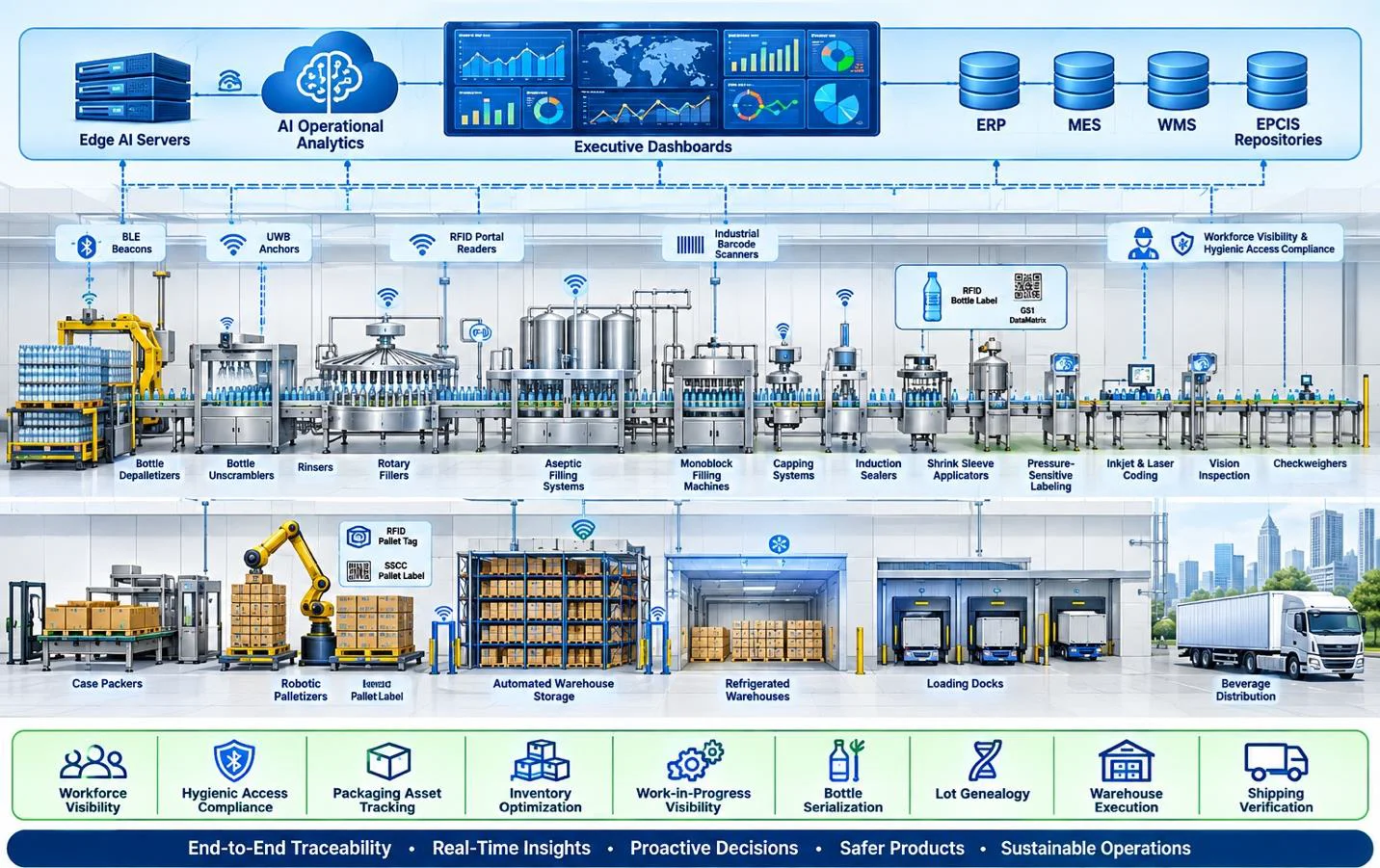
AI-Assisted Operational Analytics Across Beverage Packaging & Bottling Operations
This enterprise workflow diagram illustrates a complete AI-assisted beverage packaging and bottling operation, spanning bottle handling, filling, sealing, labeling, coding, inspection, case packing, palletizing, warehousing, and distribution. It highlights the integration of RFID, GS1 DataMatrix, SSCC pallet labels, BLE, UWB, barcode scanning, Edge AI, ERP, MES, WMS, EPCIS, and executive dashboards to enable real-time operational analytics, end-to-end traceability, workforce visibility, inventory optimization, bottle serialization, lot genealogy, warehouse execution, and shipping verification.
Label Roll Inventory Analytics
Packaging facilities often manage thousands of label variations supporting multiple beverage brands, package sizes, multilingual labeling requirements, nutritional declarations, regulatory information, promotional campaigns, customer-specific packaging, and export markets.
AI continuously analyzes identification records associated with:
- Pressure-sensitive labels
- Shrink sleeve labels
- Wrap-around labels
- GS1 barcode labels
- GS1 DataMatrix labels
- Serialized labels
- Variable data labels
- Promotional labels
- Regulatory labels
- Carton labels
- Pallet labels
- Shipping labels
Operational analytics identify:
- Label consumption trends
- Production-specific label demand
- Warehouse replenishment timing
- Inventory aging
- Label allocation by production order
- Packaging changeover preparation
- Warehouse picking efficiency
- Inventory accuracy improvements
- Storage optimization
- Production scheduling support
Engineering teams and warehouse planners use these insights to reduce packaging interruptions, improve inventory planning, minimize obsolete inventory, and ensure that correct labels remain available for every scheduled production run.
Bottling Production Analytics
Packaging and bottling operations depend upon synchronized coordination across filling systems, labeling equipment, inspection stations, packaging cells, warehouse operations, and outbound logistics. Maintaining high Overall Equipment Effectiveness (OEE) requires continuous operational visibility throughout every production stage.
AI production analytics transform identification and location events into operational solution that supports production managers, manufacturing engineers, maintenance planners, warehouse supervisors, and continuous improvement teams.
Rather than replacing Manufacturing Execution Systems (MES), AI complements existing enterprise software by identifying operational trends, recognizing production constraints, forecasting workflow disruptions, improving production sequencing, and supporting data-driven operational decisions.
Packaging Work-In-Progress Analytics
Packaging work-in-progress (WIP) consists of products actively progressing through production but not yet released as finished goods. Maintaining continuous WIP visibility enables production managers to balance packaging throughput, reduce intermediate inventory accumulation, improve production sequencing, and increase line efficiency.
AI evaluates identification events across:
- Bottle depalletizing
- Bottle unscrambling
- Bottle rinsing
- Rotary filling
- Monoblock filling
- Aseptic filling
- Bottle capping
- Induction sealing
- Shrink sleeve application
- Pressure-sensitive labeling
- Inkjet coding
- Laser marking
- Vision inspection
- Checkweighing
- Case packing
- Tray packing
- Robotic palletizing
- Stretch wrapping
- Warehouse staging
Operational analytics identify:
- Production queue buildup
- Packaging flow interruptions
- Material replenishment delays
- Intermediate inventory accumulation
- Packaging line synchronization issues
- Warehouse transfer timing
- Packaging order progress
- Changeover readiness
- Dispatch preparation
- Production balancing opportunities
These insights enable production supervisors to improve packaging throughput while minimizing unnecessary work-in-progress inventory throughout the manufacturing process.
Bottling Batch Progress Analytics
Every beverage production batch progresses through multiple controlled manufacturing stages before being released for customer shipment. Accurate visibility into batch status enables production planning, warehouse coordination, quality assurance scheduling, and customer fulfillment.
AI continuously evaluates identification records associated with:
- Production order release
- Batch initiation
- Filling verification
- Closure verification
- Label application
- Coding validation
- Vision inspection
- Case formation
- Pallet assembly
- Warehouse receiving
- Quality release
- Shipment preparation
Historical production analytics enable manufacturing teams to compare current production runs with previous batches, identify recurring delays, improve scheduling accuracy, optimize labor allocation, and strengthen operational consistency across multiple packaging lines.
Packaging Line Throughput Analytics
Packaging throughput depends upon synchronized operation of every production asset. Minor reductions in throughput at a single workstation frequently create downstream production constraints affecting the entire packaging process.
AI continuously evaluates operational performance across:
- Bottle depalletizers
- Bottle unscramblers
- Rotary fillers
- Monoblock fillers
- Aseptic filling systems
- Cap feeding systems
- Bottle cappers
- Induction sealers
- Shrink sleeve applicators
- Pressure-sensitive labelers
- Inkjet coding systems
- Laser marking equipment
- Vision inspection systems
- Checkweighers
- Case packers
- Tray packers
- Robotic palletizers
- Stretch wrappers
- Conveyor systems
- Automated warehouse interfaces
Operational analytics identify:
- Throughput variations
- Shift-to-shift performance differences
- Equipment utilization trends
- Packaging line balancing opportunities
- Capacity utilization
- Resource allocation effectiveness
- Idle production periods
- Packaging efficiency improvements
- Continuous improvement opportunities
- Operational consistency
These AI-generated operational insights support lean manufacturing initiatives, continuous improvement programs, and long-term production optimization while maintaining consistent packaging quality.
Filling Line Bottleneck Analytics
Even highly automated beverage facilities periodically experience bottlenecks resulting from production scheduling, packaging material availability, warehouse coordination, product changeovers, equipment utilization, workforce allocation, and finished goods handling.
AI continuously evaluates identification and location events throughout production to identify developing bottlenecks before they significantly reduce packaging throughput.
Typical bottleneck analysis includes:
- Bottle accumulation
- Conveyor congestion
- Closure replenishment delays
- Label inventory shortages
- Packaging material availability
- Case packing delays
- Pallet removal timing
- Warehouse staging congestion
- Finished goods transfer delays
- Production sequencing conflicts
- Changeover preparation
- Shipping coordination
Historical operational analytics help manufacturing engineers redesign production workflows, improve packaging line balancing, optimize warehouse coordination, reduce downtime, and maximize Overall Equipment Effectiveness (OEE).
Product Traceability Analytics
Comprehensive traceability has become a strategic operational requirement throughout the Food & Beverage Manufacturing Industry. Regulatory compliance, retailer mandates, food safety programs, export requirements, and consumer expectations require manufacturers to maintain complete product genealogy throughout production, warehousing, transportation, and distribution.
AI-assisted traceability analytics transform identification events into complete digital product histories linking raw packaging materials, finished products, warehouse inventory, logistics operations, and customer shipments.
Rather than simply recording historical events, AI continuously analyzes operational relationships to identify inconsistencies, documentation gaps, process deviations, and opportunities for continuous operational improvement.
Comprehensive traceability supports compliance with GS1 identification standards, EPCIS event management, FSMA, HACCP, BRCGS, SQF, ISO 22000, retailer traceability requirements, and enterprise quality management systems.
Bottle Serialization Analytics
Bottle serialization assigns a unique digital identity to every product throughout manufacturing and distribution.
AI continuously evaluates serialization events associated with:
- Individual bottles
- Multipacks
- Beverage cases
- Shipping cartons
- Mixed pallets
- Logistics units
Operational analytics improve:
- Serialization verification
- Duplicate identifier detection
- Packaging sequence validation
- Shipment verification
- Distribution visibility
- Product authentication
- Regulatory documentation
- Recall preparedness
- Supply chain transparency
- Operational auditing
These capabilities strengthen regulatory compliance while improving consumer confidence, brand protection, and end-to-end supply chain visibility.
Case Traceability Analytics
Finished cases move through receiving, warehouse storage, automated retrieval, order fulfillment, cross-docking, transportation, and customer delivery before reaching retailers, distributors, and food service organizations.
AI continuously analyzes identification histories across every logistics stage to improve:
- Warehouse location accuracy
- Inventory allocation
- Shipping verification
- Order fulfillment accuracy
- Customer allocation
- Distribution planning
- Cross-docking efficiency
- Recall readiness
- Product genealogy
- Warehouse productivity
Comprehensive case-level traceability enables organizations to respond rapidly to customer inquiries, quality investigations, retailer audits, and regulatory inspections.
Packaging Lot Genealogy Analytics
Lot genealogy establishes complete operational relationships between packaging materials, production batches, warehouse inventory, logistics activities, and customer shipments.
AI continuously correlates identification events linking:
- Bottle production lots
- Closure lots
- Label lots
- Carton lots
- Corrugated case lots
- Pallet identifiers
- Production batches
- Warehouse storage locations
- Distribution records
- Customer shipments
Comprehensive genealogy records support supplier performance evaluation, root cause investigations, corrective action management, product recall execution, regulatory reporting, continuous improvement initiatives, and enterprise quality management.
Cold Chain Beverage Traceability Analytics
Many packaged beverages require controlled handling throughout refrigerated warehousing and distribution to preserve product quality and comply with operational procedures.
AI continuously evaluates identification events associated with:
- Cold storage warehouses
- Refrigerated staging areas
- Distribution centers
- Cross-docking facilities
- Shipping preparation
- Warehouse transfers
- Retail allocation
- FEFO inventory rotation
- Return logistics
- Distribution verification
Operational analytics improve warehouse planning, inventory allocation, shipment sequencing, warehouse execution, logistics coordination, and cold chain documentation while strengthening operational transparency across refrigerated beverage distribution networks.
Business Benefits for Packaging & Bottling Operations
Packaging and bottling facilities operate in highly competitive environments where production throughput, packaging quality, product traceability, warehouse efficiency, workforce productivity, and regulatory compliance directly influence profitability and customer satisfaction. AI and IoT solutions built around identification and location technologies provide measurable operational improvements without requiring manufacturers to replace existing ERP, MES, WMS, or quality management software.
Rather than functioning as isolated software, AI continuously analyzes identification and location data generated throughout production, packaging, warehousing, and distribution to support faster operational decisions, improve production planning, and enhance enterprise-wide visibility.
Organizations implementing AI-assisted packaging and bottling solutions commonly achieve improvements in:
- Workforce productivity and operational coordination
- Hygienic access compliance and controlled production area management
- Packaging equipment utilization
- Returnable asset visibility
- Warehouse inventory accuracy
- Finished goods tracking
- Packaging material replenishment planning
- Packaging line throughput
- Work-in-progress visibility
- Production scheduling accuracy
- Bottle serialization management
- Lot genealogy documentation
- Cold chain logistics coordination
- Warehouse dispatch efficiency
- Distribution planning
- Enterprise reporting and operational decision support
These operational improvements contribute to lower operating costs, higher Overall Equipment Effectiveness (OEE), improved regulatory compliance, stronger supply chain resilience, and greater production consistency across single-site and multi-site manufacturing operations.
Why Organizations Choose PackBottle AI
PackBottle AI develops AI and IoT software specifically for packaging and bottling operations within the Food & Beverage Manufacturing Industry. Every solution is designed around real manufacturing workflows including beverage filling, packaging automation, warehouse logistics, returnable packaging management, serialization, pallet handling, distribution, and product traceability.
Unlike generic industrial software, PackBottle AI focuses on identification and location technologies that support operational visibility across production lines, packaging equipment, warehouses, and distribution facilities.
Our experience is built upon practical deployment knowledge gained through thousands of enterprise IoT implementations. Developed within Aperture Venture Studio with support from GAO, PackBottle AI benefits from more than two decades of industrial IoT experience serving thousands of customers across manufacturing, logistics, warehousing, and industrial operations.
Continuous investment in research and development, rigorous quality assurance, and expert engineering support enables PackBottle AI to deliver technically accurate, scalable, and reliable AI and IoT software for complex packaging environments. Our engineering leadership includes Ph.D. professionals supported by experienced industrial specialists, strategic technology partners, and extensive field deployment expertise. Our solutions have supported Fortune 500 manufacturers, leading research organizations, prestigious universities, and government agencies throughout the United States and Canada.
Organizations select PackBottle AI because our solutions provide:
- Packaging-specific operational expertise
- Enterprise-grade AI and IoT software
- Deep knowledge of identification and location technologies
- Proven RFID, BLE, UWB, LoRaWAN, Wi-Fi, GPS, OPC UA, and MQTT integration expertise
- Flexible cloud, on-premises, and hybrid deployment options
- Scalable multi-plant implementation support
- Remote and on-site engineering assistance
- Long-term technical support and lifecycle management
- Standards-based enterprise integration
- Strong commitment to operational reliability and cybersecurity
Begin Your AI and IoT Packaging Transformation
Packaging and bottling operations continue to evolve as manufacturers pursue higher production efficiency, greater product traceability, improved warehouse execution, and more resilient supply chains. Achieving these objectives requires more than isolated automation. It requires operational visibility that connects workforce activities, production assets, packaging materials, finished goods, and distribution workflows into a unified decision-support process.
PackBottle AI delivers AI and IoT software that transforms identification and location data into actionable operational insights across packaging lines, bottling facilities, warehouses, cold storage operations, and distribution networks. By integrating with existing ERP, MES, WMS, SCADA, and quality management systems, organizations can improve production planning, optimize packaging workflows, strengthen traceability, and enhance operational performance without disrupting established manufacturing processes.
Whether your organization operates a single bottling facility or manages multiple production plants across different regions, PackBottle AI provides scalable solutions that support workforce visibility, hygienic access compliance, asset tracking, inventory optimization, work-in-progress management, bottle serialization, lot genealogy, and cold chain traceability.
Contact PackBottle AI
Contact PackBottle AI to discuss your operational requirements, evaluate your existing identification infrastructure, and design a deployment strategy that improves packaging efficiency, warehouse visibility, product traceability, regulatory compliance, and long-term operational performance.