
Overview of IoT Software for AIoT-Enabled Packaging & Bottling Operations
Packaging and bottling operations represent one of the most demanding manufacturing environments within the Food & Beverage Manufacturing Industry. Modern production facilities routinely process hundreds of thousands of bottles, cans, cartons, cases, trays, and pallets every shift while maintaining strict food safety, regulatory compliance, production efficiency, and product quality requirements. Every production stage, from empty container receiving through bottle unscrambling, rinsing, filling, capping, induction sealing, labeling, coding, inspection, case packing, robotic palletizing, warehouse staging, cold storage, and distribution, depends on accurate identification and continuous operational visibility.
Traditional production reporting often relies on barcode scans, manual data entry, or isolated machine data, leaving operational teams with delayed or incomplete information regarding personnel, packaging assets, inventory, production progress, and finished goods movement. High-speed production lines generating hundreds of containers per minute require more sophisticated identification and location technologies capable of supporting continuous operational decision-making.
AI of Things, commonly referred to as AIoT or AI and IoT, combines AI with industrial IoT devices, connected equipment, industrial identification technologies, and enterprise software. Within packaging and bottling operations, AI and IoT focuses primarily on identification and location technologies rather than environmental sensing. RFID labels, BLE beacons, UWB positioning systems, industrial barcode identification, Wi-Fi connectivity, LoRaWAN infrastructure, GPS fleet tracking, and enterprise communication protocols work together to create accurate digital records of operational activities throughout the production lifecycle.
PackBottle AI organizes these identification events into structured operational workflows that support packaging workforce coordination, hygienic access compliance, returnable packaging management, warehouse inventory accuracy, packaging work-in-progress, bottle serialization, batch genealogy, finished goods logistics, and enterprise reporting. The software complements existing manufacturing systems by improving operational visibility without disrupting established production processes.
Enterprise Architecture for AI-Enabled Packaging & Bottling Operations
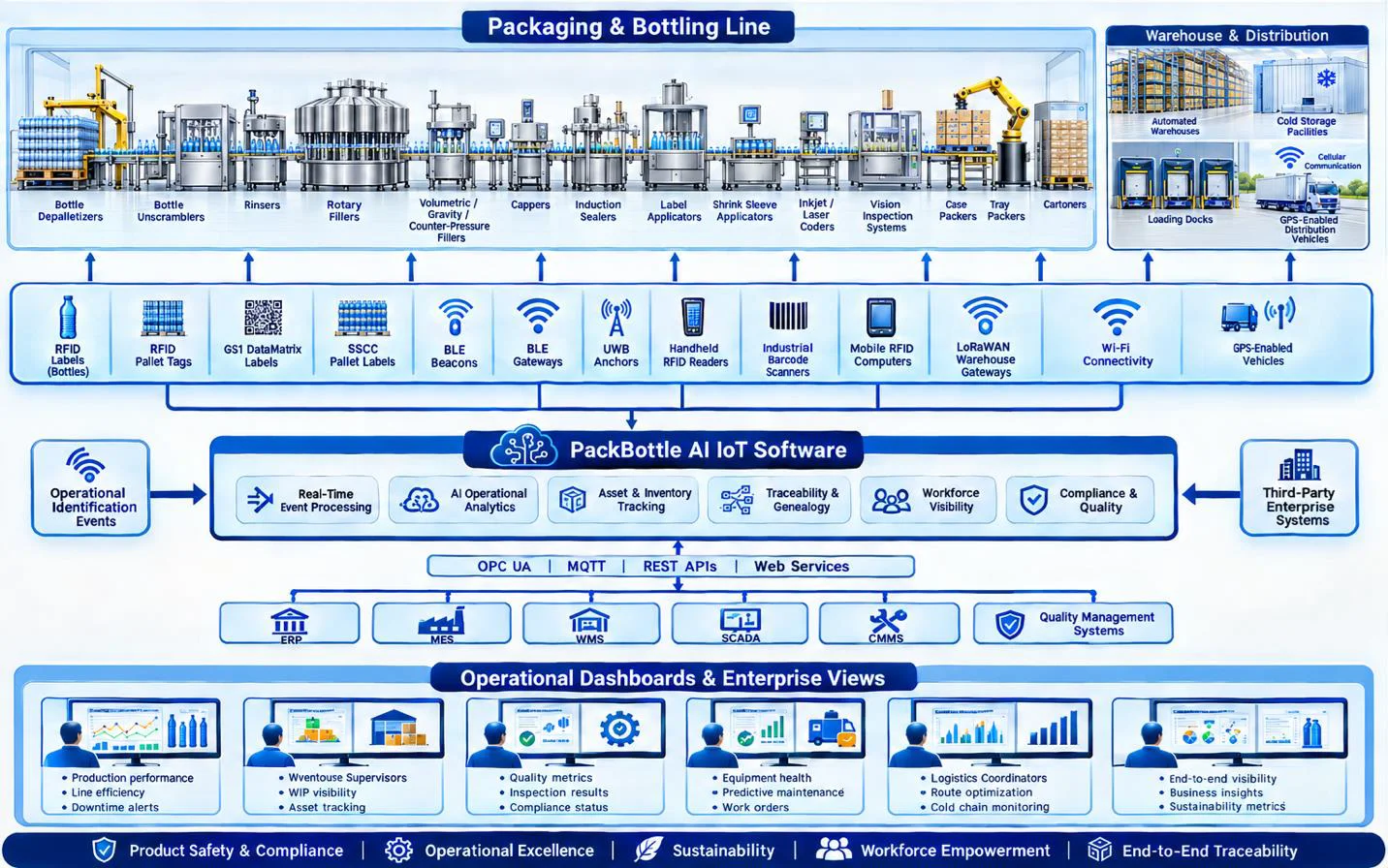
This enterprise architecture diagram illustrates how AI-powered IoT software integrates production equipment, industrial identification technologies, warehouse operations, enterprise applications, and beverage distribution into a unified digital platform. It shows operational data flowing through RFID, BLE, UWB, barcode scanning, Wi-Fi, LoRaWAN, and GPS connectivity into PackBottle AI IoT Software, which integrates with ERP, MES, WMS, SCADA, CMMS, and Quality Management Systems using OPC UA and MQTT. The architecture delivers real-time operational dashboards supporting workforce visibility, packaging asset tracking, inventory management, bottle serialization, batch genealogy, warehouse execution, predictive maintenance, and end-to-end cold chain distribution visibility.
Operational Challenges in Modern Packaging & Bottling Facilities
Food and beverage packaging facilities continue to increase production capacity while simultaneously introducing greater product variety, shorter production runs, more frequent product changeovers, and stricter regulatory requirements. These operational demands create significant challenges that cannot always be addressed using conventional manufacturing software alone.
Common operational challenges include:
- Locating maintenance technicians during unexpected packaging line stoppages.
- Managing personnel access to hygienic filling rooms and controlled production zones.
- Tracking reusable pallets, beverage crates, roll cages, totes, and other returnable transport items.
- Monitoring the availability of PET bottles, glass bottles, aluminum cans, caps, closures, labels, shrink sleeves, cartons, corrugated cases, and stretch wrap.
- Coordinating packaging work-in-progress across multiple filling and packaging lines.
- Maintaining accurate bottle serialization and packaging lot genealogy.
- Improving warehouse inventory accuracy for finished goods and packaging materials.
- Coordinating robotic palletizing and warehouse staging operations.
- Supporting FEFO (First Expired, First Out) inventory practices.
- Maintaining complete traceability for product recalls and regulatory audits.
- Synchronizing operational events across ERP, MES, WMS, SCADA, CMMS, and Quality Management Systems.
Industrial AI and IoT software addresses these challenges by transforming identification events into actionable operational workflows. Rather than presenting isolated RFID reads or barcode transactions, the software correlates identification data with production orders, packaging batches, warehouse transactions, and logistics activities, providing plant personnel with contextual information that supports faster and more informed operational decisions.
Core Software Functions
PackBottle AI organizes industrial IoT data into specialized software modules aligned with the operational requirements of packaging and bottling facilities.
Packaging Workforce Software
Packaging operations require close coordination among line operators, sanitation personnel, maintenance technicians, warehouse staff, quality inspectors, forklift operators, supervisors, and contractors. Workforce software helps production teams improve personnel visibility, shift coordination, emergency accountability, and controlled-area access while supporting food safety procedures and Good Manufacturing Practices (GMP).
Packaging Asset Software
Packaging facilities depend on the continuous availability of reusable operational assets, including returnable beverage crates, pallets, roll cages, forklifts, mobile carts, handheld RFID readers, barcode scanners, calibration instruments, maintenance tools, and packaging equipment. Asset software improves utilization, reduces search times, supports preventive maintenance planning, and provides accurate location histories throughout production and warehouse operations.
Packaging Inventory Software
Packaging inventory extends far beyond finished products. Facilities must continuously manage PET preforms, glass bottles, aluminum cans, HDPE containers, bottle caps, crown closures, labels, shrink sleeves, cartons, corrugated cases, adhesive materials, trays, pallets, returnable containers, promotional packaging materials, and finished packaged beverages. Inventory software improves stock accuracy, production replenishment, warehouse organization, and outbound logistics while reducing material shortages and unnecessary inventory carrying costs.
Bottling Production Software
Production software provides visibility into packaging work-in-progress, bottling batches, production sequencing, line throughput, pallet completion, warehouse transfers, and finished goods staging. Operational workflows help production supervisors monitor manufacturing progress while improving scheduling accuracy, reducing manual reporting, and supporting Overall Equipment Effectiveness (OEE) improvement initiatives.
Product Traceability Software
Comprehensive traceability remains essential throughout food and beverage manufacturing. The software associates bottles, cans, cartons, cases, pallets, production lots, and outbound shipments with complete identification histories, enabling rapid product genealogy analysis, regulatory documentation, customer shipment verification, and efficient product recall management.
Packaging Workforce Software
Packaging and bottling facilities rely on highly coordinated production teams operating across bottle depalletizing, container unscrambling, rinsing, filling, capping, induction sealing, label application, coding, vision inspection, case packing, robotic palletizing, warehouse staging, sanitation, maintenance, quality assurance, and outbound shipping. Production often operates continuously in multiple shifts, making accurate workforce visibility essential for maintaining throughput, regulatory compliance, and workplace safety.
PackBottle AI provides industrial AI and IoT software that transforms identification and location events into operational workforce workflows specifically designed for packaging and bottling operations. Rather than functioning as a traditional personnel management application, the software continuously organizes workforce activities around production operations, enabling supervisors to understand where authorized personnel are located, how production teams are distributed, and whether critical operational areas are adequately staffed.
Identification technologies including RFID credentials, BLE badges, UWB positioning, industrial barcode identification, and secure Wi-Fi connectivity provide accurate personnel identification while respecting operational security and food safety requirements. AI-assisted event processing helps distinguish routine movement from operational exceptions, enabling supervisors to respond more quickly to production disruptions without relying on manual communication or periodic attendance checks.
Typical workforce activities supported include:
- Packaging line staffing.
- Filling room operator assignment.
- Shift transition coordination.
- Maintenance technician dispatch.
- Warehouse labor allocation.
- Contractor identification.
- Emergency accountability.
- Production support activities.
- Controlled-area access management.
- Workforce utilization reporting.
These capabilities help packaging operations improve labor coordination while maintaining uninterrupted production across high-speed filling and packaging lines.
Packaging Personnel Location Software
Personnel continuously move between production cells, warehouse aisles, maintenance workshops, clean-in-place (CIP) preparation rooms, utilities areas, packaging material storage, quality laboratories, dispatch zones, and cold storage facilities.
Real-time operational visibility enables production supervisors to:
- Locate maintenance personnel during equipment failures.
- Coordinate sanitation teams during production changeovers.
- Verify operator presence on active packaging lines.
- Improve shift handover efficiency.
- Support emergency response procedures.
- Coordinate quality inspection activities.
- Reduce communication delays.
- Improve production scheduling.
Unlike conventional attendance systems, the software emphasizes operational coordination throughout active manufacturing workflows rather than simply recording employee presence.
Filling Zone Compliance Software
Food safety regulations require strict control over access to hygienic production areas. Unauthorized movement into bottle rinsing rooms, aseptic filling areas, clean packaging environments, quality laboratories, ingredient preparation rooms, and quarantine storage areas may introduce operational risks and regulatory concerns.
The software verifies authorized access using secure industrial identification technologies while maintaining detailed event histories for regulatory documentation and internal auditing.
Controlled operational areas commonly include:
- Bottle rinsing rooms.
- Aseptic filling suites.
- Rotary filler enclosures.
- High-hygiene packaging zones.
- Clean packaging cells.
- Ingredient preparation rooms.
- Quality laboratories.
- Product quarantine storage.
- Finished goods release areas.
- Cold beverage storage.
Historical access records simplify compliance verification while supporting internal investigations when operational anomalies occur.
Packaging Shift Attendance Software
Packaging facilities frequently operate twenty-four hours per day across rotating production shifts. Coordinating operators, sanitation personnel, warehouse staff, quality technicians, mechanics, electricians, and contract workers requires accurate workforce documentation integrated with production schedules.
The software supports:
- Shift start verification.
- Shift completion documentation.
- Crew assignment management.
- Overtime reporting.
- Temporary workforce management.
- Contractor attendance.
- Department staffing analysis.
- Production labor allocation.
Operational managers receive accurate workforce information before assigning personnel to filling lines, labeling equipment, palletizing cells, warehouse operations, and dispatch activities.
Packaging Emergency Mustering Software
Emergency preparedness remains a critical operational requirement in facilities operating industrial refrigeration systems, compressed air networks, carbon dioxide systems, ammonia refrigeration equipment, automated conveyors, robotic palletizers, forklifts, and electrical distribution equipment.
During emergency evacuation procedures, the software rapidly compares personnel identification records with designated assembly locations to verify workforce accountability.
The software assists organizations by supporting:
- Personnel accountability.
- Visitor verification.
- Contractor mustering.
- Emergency response coordination.
- Assembly area reporting.
- Incident documentation.
- Regulatory reporting.
- Business continuity planning.
Rapid personnel verification reduces uncertainty during emergency situations while helping organizations improve workplace safety and operational readiness.
Packaging Asset Software
Packaging and bottling operations depend on thousands of reusable operational assets that move continuously between production lines, warehouses, maintenance departments, distribution centers, and customer return networks. Misplaced assets can delay production, reduce equipment utilization, and increase unnecessary replacement costs.
PackBottle AI provides industrial IoT software that records asset movement using RFID, BLE, UWB, barcode identification, and mobile industrial computing technologies. AI-assisted analytics organize asset movement histories into operational workflows that support production planning, warehouse logistics, maintenance scheduling, and asset lifecycle management.
Common tracked assets include:
- Returnable beverage crates.
- Plastic pallets.
- Wooden pallets.
- Roll cages.
- Intermediate bulk containers.
- Stainless steel totes.
- Mobile packaging carts.
- Forklifts.
- Pallet jacks.
- Handheld RFID readers.
- Industrial barcode scanners.
- Mobile data terminals.
- Calibration equipment.
- Torque tools.
- Maintenance instruments.
- Portable printers.
- Packaging change parts.
Maintaining accurate location histories improves operational efficiency while reducing asset search times throughout production facilities.
End-to-End AI-Enabled Workflow for Beverage Packaging & Bottling Operations
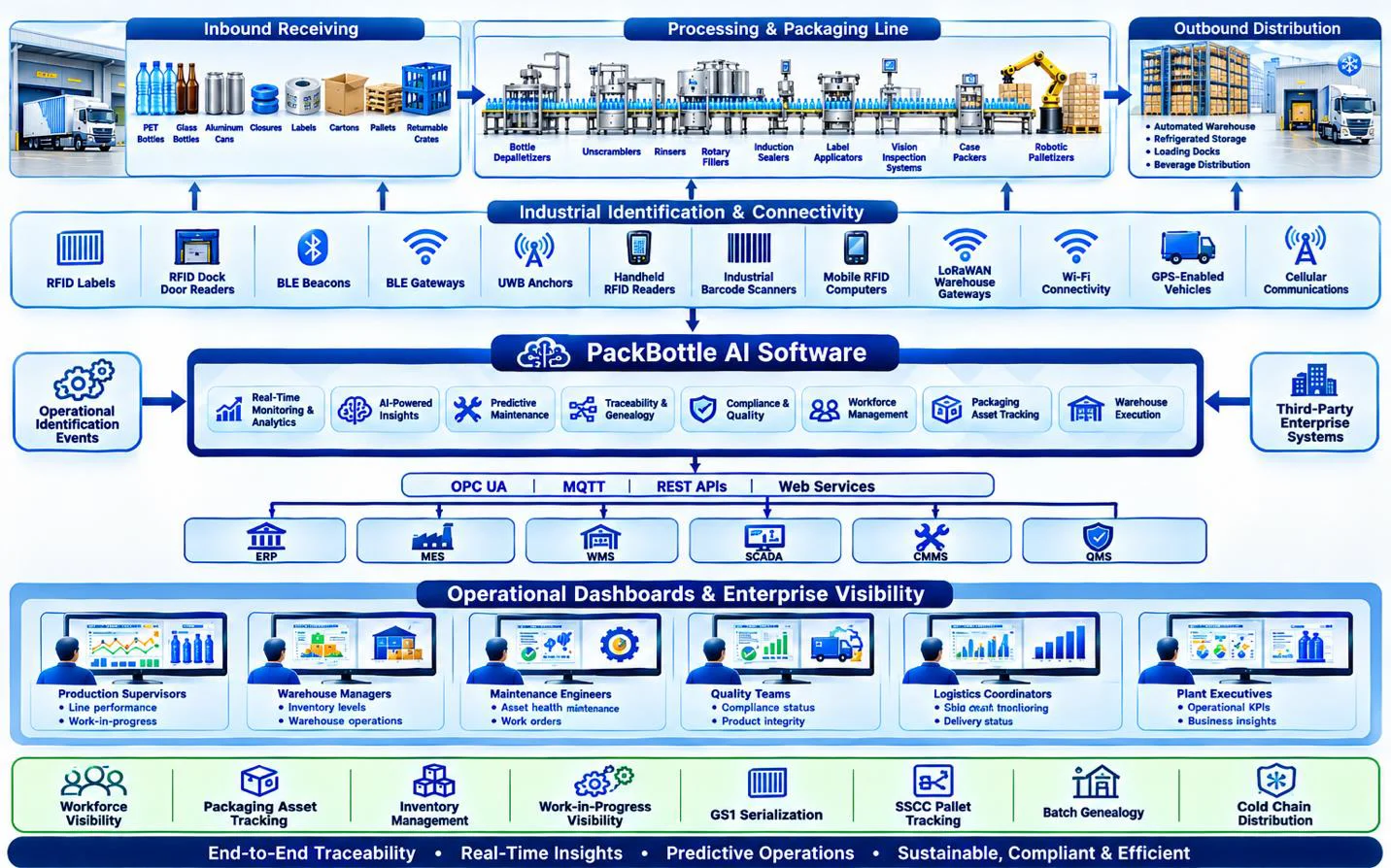
This workflow diagram illustrates the complete operational flow of a modern beverage packaging and bottling facility, from inbound material receiving through automated production, warehousing, and outbound distribution. It shows how RFID, BLE, UWB, barcode scanning, LoRaWAN, Wi-Fi, GPS, and cellular technologies capture operational events that are processed by PackBottle AI Software and integrated with ERP, MES, WMS, SCADA, CMMS, and QMS using OPC UA and MQTT. The solution provides real-time dashboards for production, warehouse, quality, maintenance, logistics, and executive teams, enabling workforce visibility, asset tracking, inventory management, GS1 serialization, SSCC pallet tracking, batch genealogy, and end-to-end cold chain distribution visibility.
Returnable Packaging Asset Software
Returnable transport items (RTIs) represent a significant operational investment for beverage manufacturers. Beverage crates, reusable pallets, returnable bottles, kegs, reusable containers, and transport racks continuously circulate between production facilities, warehouses, distributors, retailers, and recovery operations.
The software helps organizations:
- Improve RTI utilization.
- Reduce asset losses.
- Monitor circulation cycles.
- Support return logistics.
- Schedule maintenance activities.
- Improve inventory balancing.
- Analyze asset lifecycle performance.
- Document asset movement histories.
Historical movement records help logistics teams optimize reusable packaging availability across multiple manufacturing locations.
Beverage Pallet Tracking Software
Finished goods pallets move through palletizing cells, stretch wrapping stations, warehouse staging areas, cold storage facilities, loading docks, cross-docking operations, and outbound transportation.
The software provides accurate pallet identification throughout these operational stages while supporting:
- Warehouse slotting.
- Shipment verification.
- Distribution planning.
- Export documentation.
- Customer shipment validation.
- Inventory reconciliation.
- Dock scheduling.
- Finished goods visibility.
Integration with Warehouse Management Systems improves shipping accuracy while reducing manual verification activities.
Packaging Forklift Tracking Software
Forklifts perform continuous material handling activities involving empty bottles, aluminum cans, pallets, labels, cartons, finished products, returnable packaging, and warehouse replenishment.
The software organizes forklift activity to support:
- Equipment utilization analysis.
- Traffic flow optimization.
- Material replenishment coordination.
- Equipment availability.
- Operator accountability.
- Maintenance scheduling.
- Warehouse productivity analysis.
- Fleet management reporting.
Operational managers can better allocate equipment based on production demand while minimizing unnecessary travel across warehouse operations.
Packaging Tool Tracking Software
Maintenance teams depend upon specialized calibration instruments, handheld diagnostic equipment, RFID readers, barcode scanners, torque tools, electrical testing equipment, vision system calibration devices, and production changeover tooling.
The software assists maintenance organizations by:
- Locating critical tools quickly.
- Reducing equipment replacement costs.
- Improving maintenance response times.
- Supporting calibration management.
- Recording tool utilization.
- Maintaining equipment accountability.
- Documenting maintenance asset histories.
Accurate tool visibility contributes to faster corrective maintenance and more efficient preventive maintenance activities.
Packaging Inventory Software
Packaging inventory management extends well beyond finished beverage products. Successful packaging operations depend upon maintaining accurate inventories of primary packaging materials, secondary packaging components, tertiary shipping materials, returnable packaging assets, and finished goods throughout the manufacturing process.
Even brief shortages of PET bottles, glass bottles, aluminum cans, crown closures, screw caps, shrink sleeves, pressure-sensitive labels, corrugated cases, adhesive materials, carrier trays, stretch film, or pallets can interrupt production on high-speed filling lines.
PackBottle AI organizes industrial identification events into accurate inventory workflows that improve warehouse visibility while supporting production continuity and logistics coordination.
Packaging Material Inventory Software
Packaging material inventory software supports receiving, warehouse storage, production replenishment, line-side inventory management, and supplier coordination.
Common managed inventory includes:
- PET bottle preforms.
- Glass bottles.
- Aluminum beverage cans.
- HDPE containers.
- Crown caps.
- Plastic closures.
- Tamper-evident seals.
- Pressure-sensitive labels.
- Shrink sleeve labels.
- Corrugated cartons.
- Beverage trays.
- Stretch film.
- Pallets.
- Returnable crates.
- Promotional packaging materials.
Accurate inventory visibility enables production planners to schedule manufacturing campaigns confidently while reducing emergency replenishment activities and minimizing excess inventory.
Finished Pack Inventory Software
Finished packaged beverages represent the final output of packaging operations and must remain synchronized with production schedules, warehouse activities, customer orders, distribution planning, and transportation logistics.
The software supports:
- Finished goods verification.
- Warehouse location management.
- FEFO inventory rotation.
- Shipment preparation.
- Order fulfillment.
- Inventory reconciliation.
- Export documentation.
- Distribution coordination.
- Customer delivery verification.
Accurate finished goods inventory improves warehouse efficiency, reduces shipping errors, enhances customer service, and strengthens traceability throughout beverage distribution operations.
Bottling Production Software
Packaging and bottling operations are characterized by continuous, high-speed production where bottle depalletizers, container unscramblers, rinsers, rotary fillers, gravity fillers, volumetric fillers, counter-pressure fillers, cappers, induction sealers, label applicators, shrink sleeve applicators, laser coders, inkjet coders, vision inspection systems, checkweighers, case packers, tray packers, cartoners, robotic palletizers, and automated warehouse systems must operate in synchronization. Maintaining uninterrupted product flow across these interconnected processes is essential for maximizing throughput, minimizing waste, and consistently achieving production targets.
PackBottle AI provides industrial AI and IoT software that organizes identification events into production workflows tailored specifically for packaging and bottling operations. Rather than simply displaying equipment events, the software correlates production orders, packaging batches, workforce activities, packaging material movements, pallet transfers, warehouse transactions, and enterprise records into a unified operational view.
Using industrial identification technologies including RFID, BLE, UWB, industrial barcode systems, Wi-Fi, LoRaWAN, GPS, and enterprise communication protocols such as OPC UA and MQTT, the software creates continuously updated production records that support operational decision-making without disrupting existing manufacturing processes.
Typical production workflows supported include:
- Packaging order execution.
- Filling line coordination.
- Packaging line synchronization.
- Changeover management.
- Batch progression.
- Packaging work-in-progress visibility.
- Finished goods transfer.
- Warehouse staging.
- Distribution preparation.
- Production reporting.
By integrating production activities with enterprise software, operations teams gain greater visibility into manufacturing progress while reducing manual reporting and improving scheduling accuracy.
Packaging Work-In-Progress Software
Packaging work-in-progress (WIP) changes rapidly as products progress through bottle preparation, filling, capping, labeling, coding, inspection, secondary packaging, palletizing, warehouse staging, and shipment preparation.
Traditional manual reporting often struggles to accurately reflect the current production status of multiple packaging lines operating simultaneously. PackBottle AI continuously organizes identification events generated throughout production to create accurate work-in-progress records.
The software supports:
- Production order visibility.
- Packaging queue management.
- Intermediate pallet tracking.
- Packaging sequence verification.
- Production completion monitoring.
- Packaging line balancing.
- Warehouse transfer coordination.
- Manufacturing reporting.
- Production scheduling support.
- Finished goods readiness.
Production supervisors can quickly identify packaging bottlenecks, monitor production flow, and coordinate downstream warehouse activities based on current operational conditions.
Bottling Batch Tracking Software
Every production batch represents a unique combination of raw materials, packaging materials, filling equipment, production personnel, quality inspections, and manufacturing documentation.
Maintaining complete batch records is essential for food safety compliance, regulatory reporting, customer quality requirements, and continuous process improvement.
The software documents identification events throughout the packaging lifecycle, supporting:
- Batch initiation.
- Filling operations.
- Packaging progression.
- Case aggregation.
- Pallet association.
- Warehouse receipt.
- Shipment preparation.
- Distribution documentation.
- Batch completion reporting.
- Historical manufacturing records.
These records simplify production analysis while providing quality teams with comprehensive documentation for audits and regulatory inspections.
Pack Traceability Software
Comprehensive traceability is fundamental to modern food and beverage manufacturing. Regulatory agencies, retailers, distributors, and consumers increasingly expect manufacturers to rapidly identify affected production lots when quality investigations or product recalls occur.
PackBottle AI links identification events throughout packaging operations to establish complete product genealogy from packaging materials through outbound distribution.
Traceability workflows support:
- GS1-compliant serialization.
- Bottle identification.
- Case aggregation.
- SSCC pallet labeling.
- Packaging lot genealogy.
- Production batch association.
- Warehouse movement history.
- Shipment verification.
- Customer delivery documentation.
- Recall preparedness.
This unified traceability approach significantly reduces the time required to investigate production issues while improving regulatory compliance and customer confidence.
Cold Chain Beverage Tracking Software
Many beverage products require controlled storage and distribution following packaging. Dairy beverages, functional beverages, nutritional drinks, ready-to-drink coffee, ready-to-drink tea, refrigerated juices, probiotic beverages, and specialty food products frequently move through refrigerated warehouses and temperature-controlled transportation networks.
Although PackBottle AI primarily focuses on identification and location technologies rather than environmental monitoring, the software maintains accurate product identification throughout cold chain logistics.
Operational workflows include:
- Cold warehouse inventory.
- Refrigerated pallet identification.
- Distribution center transfers.
- Cross-docking verification.
- Shipment documentation.
- Distribution visibility.
- Customer delivery confirmation.
- Product genealogy maintenance.
These capabilities strengthen inventory accuracy and support rapid product retrieval when required during quality investigations or recall activities.
Enterprise Software Integration
Packaging and bottling operations rely on multiple enterprise software applications to coordinate manufacturing, warehousing, logistics, maintenance, procurement, quality management, and financial operations. Industrial AI and IoT software becomes significantly more valuable when operational identification events can be exchanged with these systems in near real time.
PackBottle AI has been designed to integrate with established manufacturing software while preserving existing operational workflows. Rather than replacing enterprise applications, the software enriches them with accurate identification, location, and movement information generated throughout packaging operations.
Supported integration targets include:
- Enterprise Resource Planning (ERP).
- Manufacturing Execution Systems (MES).
- Warehouse Management Systems (WMS).
- Supervisory Control and Data Acquisition (SCADA).
- Computerized Maintenance Management Systems (CMMS).
- Quality Management Systems (QMS).
- Transportation Management Systems (TMS).
- Enterprise reporting software.
- Business analytics applications.
This integration strategy reduces duplicate data entry while improving consistency between production operations, warehouse activities, and enterprise reporting.
Packaging ERP Integration
ERP software manages purchasing, inventory valuation, production planning, order fulfillment, financial reporting, and enterprise resource management.
PackBottle AI exchanges operational information including:
- Packaging material consumption.
- Finished goods production.
- Inventory transactions.
- Batch completion.
- Shipment confirmation.
- Returnable packaging movement.
- Warehouse transfers.
- Production order status.
This synchronization improves operational accuracy while supporting enterprise-wide reporting.
Bottling MES Integration
Manufacturing Execution Systems coordinate production scheduling, work order execution, batch management, and production reporting throughout packaging operations.
MES integration supports:
- Production order synchronization.
- Packaging line execution.
- Batch progression.
- Work order completion.
- Packaging performance reporting.
- Production documentation.
- Manufacturing history.
This integration enables consistent operational visibility from production planning through finished goods completion.
Packaging WMS Integration
Warehouse Management Systems coordinate receiving, warehouse storage, replenishment, picking, staging, loading, and shipping.
Integration improves:
- Warehouse location accuracy.
- Inventory reconciliation.
- Pallet movement verification.
- Order fulfillment.
- Dock scheduling.
- Distribution planning.
- Shipment confirmation.
Warehouse personnel benefit from improved inventory visibility while reducing manual reconciliation activities.
Filling Line SCADA Integration
SCADA software supervises automated filling, capping, labeling, inspection, conveying, palletizing, and packaging equipment.
By exchanging production events between SCADA software and PackBottle AI, organizations can correlate equipment activity with identification records, packaging progression, production orders, and warehouse operations.
This relationship provides a more comprehensive operational picture for production supervisors while supporting manufacturing performance analysis and continuous improvement initiatives.
Flexible Deployment Models
Food and beverage manufacturers differ significantly in operational scale, cybersecurity policies, IT infrastructure, regulatory obligations, and business continuity requirements. Consequently, PackBottle AI supports multiple deployment models that allow organizations to select the approach best aligned with their operational and governance objectives.
Cloud Deployment
Cloud deployment is well suited for organizations operating multiple packaging plants, regional warehouses, and geographically distributed beverage production facilities.
Advantages include:
- Centralized operational reporting.
- Multi-site production visibility.
- Simplified software administration.
- Scalable computing resources.
- Remote operational access.
- Enterprise-wide reporting consistency.
On-Premises Server Deployment
Many manufacturers prefer locally managed software because production operations often require direct control over manufacturing data, integration infrastructure, and cybersecurity management.
Server deployment provides:
- Local operational control.
- Internal data governance.
- Reduced external network dependency.
- Facility-specific software configuration.
- Tight integration with manufacturing infrastructure.
Hybrid Deployment
Hybrid deployment combines local production software with centralized enterprise reporting, allowing organizations to maintain production continuity while supporting multi-site operational management.
Hybrid deployments commonly support:
- Enterprise reporting.
- Local production execution.
- Disaster recovery planning.
- Flexible expansion.
- Regional manufacturing coordination.
Multi-Plant Manufacturing Support
Large beverage manufacturers frequently operate several bottling facilities producing different brands, container sizes, package formats, and seasonal products.
PackBottle AI enables standardized reporting across all facilities while allowing each manufacturing location to maintain independent production schedules, packaging workflows, warehouse operations, and operational policies.
Packaging Edge AI Processing
High-speed packaging lines generate enormous volumes of RFID reads, barcode scans, BLE location updates, UWB positioning events, warehouse transactions, and enterprise messages every minute. Efficient processing close to production operations improves responsiveness while minimizing unnecessary communication traffic.
PackBottle AI supports Edge AI processing that validates, filters, correlates, and prioritizes identification events before synchronizing operational information with enterprise software.
Edge processing supports:
- High-speed RFID event processing.
- Barcode event filtering.
- Local workflow execution.
- Packaging line continuity.
- Offline operational capability.
- Secure enterprise synchronization.
- Event prioritization.
- Reliable production reporting.
This distributed processing approach is particularly valuable in facilities operating multiple high-speed filling lines, automated warehouses, robotic palletizing systems, extensive distribution operations, and geographically distributed manufacturing facilities.
Why Choose PackBottle AI for Packaging & Bottling Operations
Selecting industrial AI and IoT software for packaging and bottling operations requires more than evaluating software features. Beverage manufacturers, contract packagers, dairy processors, bottled water producers, breweries, wineries, edible oil processors, and food packaging facilities require solutions that integrate with existing production systems, support regulatory compliance, maintain operational continuity, and scale across multiple manufacturing sites without interrupting production.
PackBottle AI has been developed specifically for packaging and bottling operations within the Food & Beverage Manufacturing Industry. The software focuses on industrial identification and location technologies that support workforce coordination, packaging asset management, inventory accuracy, production visibility, bottle serialization, pallet tracking, warehouse logistics, and enterprise integration across high-speed manufacturing environments.
Unlike general-purpose manufacturing software, PackBottle AI aligns with packaging-specific workflows such as bottle depalletizing, container unscrambling, rotary filling, capping, induction sealing, labeling, coding, inspection, case packing, tray packing, robotic palletizing, and warehouse staging.
Contact Us
Contact PackBottle AI to discuss your operational requirements, evaluate your existing identification infrastructure, and design a deployment strategy that improves packaging efficiency, warehouse visibility, product traceability, regulatory compliance, and long-term operational performance.