
Explore industrial IoT hardware technologies for AIoT-enabled packaging and bottling operations in the Food & Beverage Manufacturing Industry.
Learn how RFID, BLE, UWB, barcode, NFC, LoRaWAN, Wi-Fi, Cellular, GPS, GS1 serialization, EPCIS traceability, and Edge AI improve bottle filling, capping, labeling, palletizing, warehouse inventory, returnable packaging, cold chain logistics, and beverage distribution.
Overview of IoT Hardware Technologies for AIoT-Enabled Packaging & Bottling Operations
Packaging and bottling operations represent some of the highest-volume production environments within the Food & Beverage Manufacturing Industry. A single production line may process tens of thousands of bottles or cans every hour while coordinating depalletizers, bottle unscramblers, rinsers, fillers, cappers, induction sealers, label applicators, vision inspection systems, date coders, case packers, robotic palletizers, pallet wrappers, automated storage systems, warehouse management software, and outbound distribution operations.
Every bottle, can, carton, shrink bundle, pallet, reusable crate, keg, returnable transport item (RTI), production tool, mobile asset, and finished shipment must be accurately identified throughout the manufacturing lifecycle. Manual identification processes become increasingly difficult as production speeds increase and product portfolios expand.
AI of Things, commonly referred to as AIoT or AI and IoT, combines AI with industrial identification devices, connected equipment, industrial communication technologies, Edge AI processing, machine learning, computer vision, and enterprise software. Within packaging and bottling environments, AIoT emphasizes identification and location technologies that capture operational events and transform them into useful business information for manufacturing, warehousing, quality assurance, maintenance, logistics, and supply chain operations.
Unlike process monitoring applications, AIoT identification solutions concentrate on answering operational questions such as:
- Where are packaging operators currently assigned?
- Which hygienic production zones have been accessed?
- Which packaging machine processed this production lot?
- Where is each returnable crate located?
- Which pallet contains a specific production batch?
- Which warehouse location stores finished inventory?
- Which shipment contains a serialized product?
- Which distribution center received a particular pallet?
- Which forklift transported a production order?
- Which production line generated a quality event?
Accurate answers to these questions improve production visibility while supporting regulatory compliance, food safety documentation, recall readiness, warehouse optimization, and operational decision-making.
Industrial identification technologies frequently deployed throughout packaging and bottling operations include:
- RFID
- BLE
- UWB
- Industrial barcode
- NFC
- LoRaWAN
- Wi-Fi
- Cellular
- GPS
- EPC-compliant RFID
- GS1 identification standards
- EPCIS event capture
- Mobile RFID computing
- Edge AI processing
Each technology addresses different operational requirements and is often deployed together to provide comprehensive visibility across manufacturing and logistics workflows.
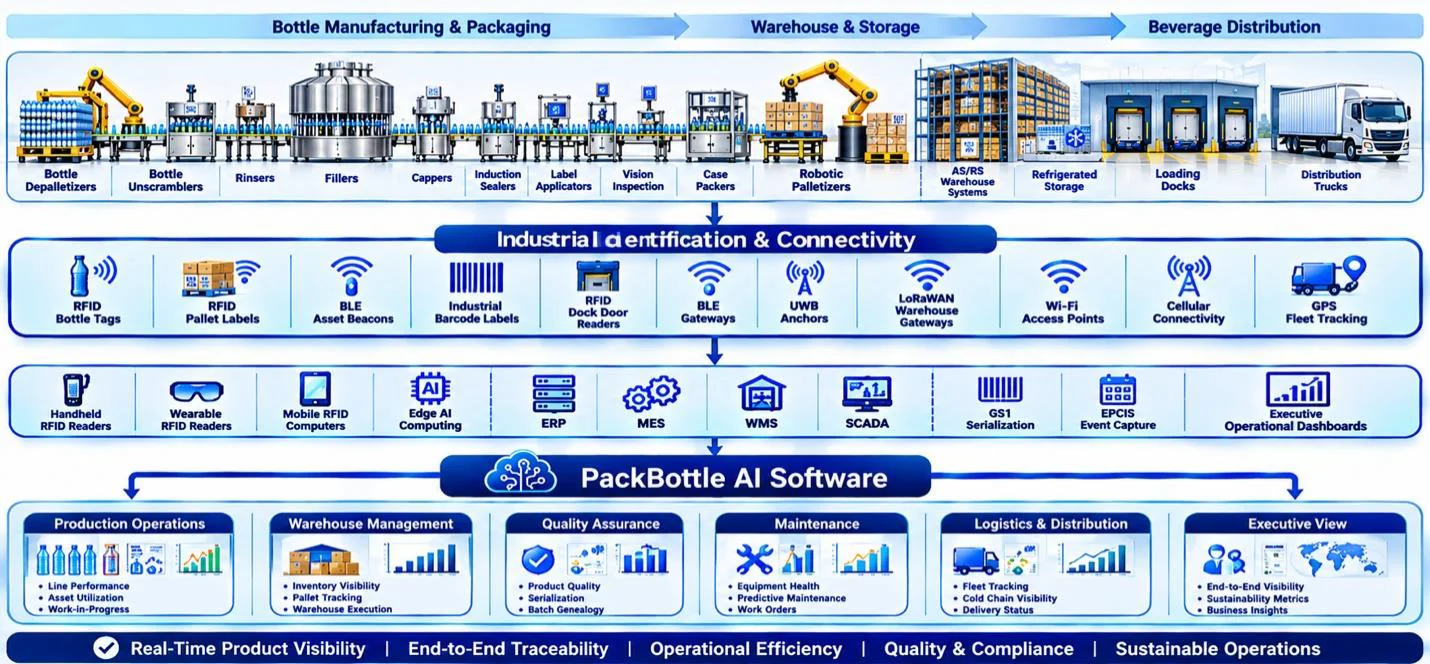
Industrial Identification Architecture for End-to-End Beverage Packaging Visibility
This block diagram illustrates how industrial identification technologies provide continuous product visibility across a modern beverage packaging and bottling operation. It shows production equipment, RFID, BLE, barcode, UWB, LoRaWAN, Wi-Fi, cellular, and GPS technologies feeding identification events into PackBottle AI Software integrated with ERP, MES, WMS, SCADA, GS1 serialization, EPCIS event capture, and executive dashboards. The architecture enables real-time production monitoring, warehouse management, quality assurance, maintenance, logistics coordination, and end-to-end traceability from packaging through distribution.
Packaging Identification Devices
Industrial identification begins with durable identification media capable of surviving high-speed production, washdown procedures, condensation, refrigerated environments, pallet handling, automated conveyors, shrink wrapping, warehouse storage, and long-distance transportation.
The identification device selected depends on production speed, packaging material, product lifecycle, traceability requirements, automation level, read distance, and customer compliance requirements. Many packaging operations deploy multiple identification technologies simultaneously to balance performance, cost, and interoperability.
The following identification devices form the foundation of AIoT-enabled packaging and bottling operations.
RFID Bottle Tags
RFID bottle tags enable non-line-of-sight identification of reusable beverage containers, refillable glass bottles, stainless steel kegs, reusable totes, and specialty beverage packaging. Unlike optical identification methods, RFID allows multiple tagged items to be identified simultaneously without requiring direct visibility.
Typical deployment scenarios include:
- Refillable bottle programs
- Brewery keg management
- Returnable transport items (RTIs)
- Beverage crate identification
- High-value product tracking
- Premium beverage packaging
- Warehouse inventory verification
- Automated dock door identification
- Distribution validation
- Reverse logistics
Major benefits include:
- Automated bulk identification
- Reduced manual scanning
- Faster warehouse throughput
- Improved returnable asset utilization
- More accurate shipment verification
- Better inventory reconciliation
- Enhanced recall preparedness
- Improved product genealogy
RFID tags designed for packaging operations are available in formats optimized for glass, plastic, corrugated cartons, reusable containers, wooden pallets, metal kegs, and plastic returnable crates, allowing manufacturers to select identification media appropriate for specific operational environments.
BLE Packaging Beacons
Bluetooth® Low Energy (BLE) beacons provide cost-effective location awareness for mobile assets that continuously move throughout packaging halls, warehouse aisles, pallet staging areas, maintenance workshops, and distribution facilities. Rather than identifying individual bottles or consumer products, BLE is typically deployed to improve the visibility of reusable operational assets and mobile equipment.
Packaging facilities commonly attach BLE beacons to:
- Forklifts
- Electric pallet jacks
- Autonomous Mobile Robots (AMRs)
- Automated Guided Vehicles (AGVs)
- Returnable transport racks
- Mobile packaging carts
- Maintenance toolboxes
- Portable quality inspection stations
- Industrial waste containers
- Mobile sanitation equipment
AI software evaluates historical movement patterns collected through BLE infrastructure to identify idle equipment, optimize fleet utilization, reduce asset search time, improve maintenance scheduling, and support production planning.
Typical operational benefits include:
- Improved equipment utilization
- Faster equipment recovery
- Reduced production delays
- Better warehouse workflow coordination
- Lower operational costs
- Enhanced workforce productivity
- Improved maintenance planning
- Greater visibility of mobile operational assets
BLE deployments are particularly effective across large bottling plants where equipment is shared between multiple packaging lines and warehouse operations.
RFID Packaging Labels
RFID packaging labels combine printed product information with embedded RFID inlays, allowing automated identification throughout packaging, warehousing, distribution, and retail logistics. Unlike traditional barcode labels, RFID labels can often be read without direct line-of-sight and can support simultaneous identification of multiple cases or pallets.
Typical deployment locations include:
- Corrugated shipping cases
- Beverage cartons
- Mixed pallets
- Finished goods pallets
- Returnable plastic crates
- Warehouse storage locations
- Shipping containers
- Cross-docking operations
Common applications include:
- Automatic pallet verification
- Warehouse receiving
- Shipping confirmation
- Finished goods inventory
- Production order validation
- Distribution center receiving
- Retail shipment preparation
- Reverse logistics
RFID labels supporting GS1 Electronic Product Code (EPC) standards improve interoperability across global supply chains while enabling EPCIS event capture for enhanced traceability and product genealogy.
Industrial Case Barcode Labels
Despite the widespread adoption of RFID, industrial barcode technology remains an essential identification method throughout packaging and bottling operations because of its simplicity, broad compatibility, and compliance with retailer and logistics requirements.
Industrial barcode labels are widely used for:
- GS1-128 shipping labels
- SSCC pallet labels
- Production batch identification
- Case identification
- Packaging material control
- Label roll management
- Warehouse inventory
- Shipping documentation
- Retail compliance labeling
- Internal logistics operations
Barcode technology complements RFID by providing a universally recognized visual identification method while supporting automated scanning throughout production and distribution workflows.
Modern industrial barcode labels often incorporate:
- GS1 DataMatrix
- GS1-128
- QR Codes
- Code 128
- Data Matrix ECC200
- Serialized product identifiers
- Production lot information
- Expiration dates
- Manufacturing timestamps
Using barcode and RFID together provides operational flexibility while supporting customer-specific labeling requirements.
Bottling Location Infrastructure
Reliable identification depends not only on identification media but also on robust industrial infrastructure that captures identification events accurately throughout production and logistics operations.
Packaging facilities present unique deployment challenges including:
- Stainless steel production equipment
- Liquid-filled products
- High-speed conveyors
- Hygienic washdown procedures
- Refrigerated warehouses
- Dense pallet storage
- Automated storage systems
- Metal racking
- Multi-level warehouse layouts
- High-throughput shipping docks
Proper infrastructure design ensures identification accuracy while minimizing operational disruption.
Key infrastructure objectives include:
- Continuous workforce visibility
- Automated pallet identification
- Packaging equipment location
- Warehouse inventory verification
- Finished goods movement
- Returnable asset management
- Production workflow visibility
- Distribution validation
- Shipping confirmation
- Multi-facility operational consistency
RFID Dock Door Readers
RFID dock door readers automatically identify tagged pallets, reusable containers, finished goods, and outbound shipments as they pass through warehouse doors without requiring operators to stop for manual scanning.
Common deployment locations include:
- Shipping docks
- Receiving docks
- Warehouse transfer doors
- Cold storage entrances
- Distribution staging lanes
- Cross-docking facilities
- Finished goods warehouses
- Returnable packaging receiving areas
Key engineering considerations include:
- Antenna polarization
- Reader transmit power
- Read zone geometry
- Conveyor speed
- Forklift traffic patterns
- Pallet orientation
- Packaging material composition
- Metal interference
- Liquid product attenuation
Proper engineering minimizes false reads, missed identifications, and duplicate transactions while supporting high-speed warehouse operations.
Typical benefits include:
- Automated shipment verification
- Reduced loading errors
- Faster truck turnaround
- Improved inventory accuracy
- Better shipping documentation
- Enhanced warehouse productivity
BLE Packaging Gateways
BLE gateways receive transmissions from Bluetooth beacons attached to mobile operational assets and forward location events to enterprise software for AI-based analysis.
Strategic deployment locations include:
- Filling departments
- Packaging halls
- Warehouse aisles
- Cartoning operations
- Palletizing cells
- Maintenance workshops
- Refrigerated warehouses
- Shipping areas
- Employee assembly points
- Equipment storage locations
AI software uses these identification events to evaluate:
- Equipment utilization
- Asset availability
- Movement frequency
- Workflow efficiency
- Shift activity
- Operational bottlenecks
- Maintenance response
- Equipment allocation
BLE gateway density should be determined through comprehensive radio frequency surveys that consider facility construction materials, equipment density, and desired positioning accuracy.
UWB Packaging Anchors
Ultra-Wideband (UWB) anchors provide precise indoor positioning for applications requiring location accuracy measured in centimeters rather than meters.
Typical deployment scenarios include:
- Automated palletizing systems
- Robotic packaging cells
- AGV navigation
- AMR fleet coordination
- High-speed packaging lines
- Forklift positioning
- Restricted production zones
- Automated warehouse intersections
Operational advantages include:
- Extremely high positioning accuracy
- Low latency
- Reliable operation within complex industrial environments
- Excellent support for automation
- High update frequency
- Improved operational coordination
UWB is particularly valuable where precise equipment positioning improves production efficiency or supports collision avoidance between automated vehicles and mobile equipment.
LoRaWAN Warehouse Gateways
Large beverage warehouses, outdoor pallet yards, distribution campuses, and returnable packaging facilities often require communication coverage extending well beyond traditional wireless networks.
LoRaWAN gateways provide reliable long-range communication suitable for geographically dispersed industrial operations.
Representative deployment areas include:
- Finished goods warehouses
- Outdoor pallet storage
- Returnable crate yards
- Beverage distribution centers
- Fleet staging areas
- Remote warehouse buildings
- Bulk packaging storage
- Multi-building production campuses
Operational benefits include:
- Long communication range
- Reduced infrastructure costs
- Reliable campus-wide coverage
- Support for warehouse expansion
- Flexible deployment
- Efficient communication across large industrial properties
When integrated with AI and IoT software, LoRaWAN helps extend identification visibility throughout large logistics operations without requiring extensive additional network infrastructure.
Packaging Mobile Identification Devices
Fixed identification infrastructure provides automated visibility throughout packaging operations, while mobile identification devices allow production operators, warehouse personnel, quality assurance teams, logistics staff, and maintenance technicians to capture identification events wherever operational activities occur.
These rugged industrial devices improve operational flexibility by supporting exception handling, inventory reconciliation, production verification, warehouse audits, shipment validation, packaging material management, and returnable asset recovery.
Modern packaging facilities frequently deploy a combination of fixed readers and mobile identification devices to maximize operational coverage while maintaining uninterrupted production.
RFID Handheld Readers
Industrial RFID handheld readers provide production operators, warehouse personnel, inventory controllers, logistics teams, and maintenance technicians with mobile identification capabilities throughout packaging and bottling operations. These rugged devices enable rapid identification of RFID-tagged pallets, reusable crates, packaging equipment, returnable transport items (RTIs), finished goods, and warehouse inventory without interrupting production flow.
Packaging and bottling facilities commonly use handheld RFID readers for:
- Finished goods inventory verification
- Warehouse cycle counting
- Returnable crate reconciliation
- Empty bottle inventory audits
- Keg identification
- Packaging material verification
- Production order validation
- Batch and lot verification
- Warehouse receiving
- Shipping confirmation
- Trailer loading verification
- Distribution center inventory audits
Enterprise-grade handheld readers typically support:
- UHF RFID (EPC Gen2 / ISO 18000-63)
- HF RFID and NFC
- Integrated barcode scanning
- Wi-Fi connectivity
- Bluetooth connectivity
- Cellular communication
- High-resolution touch displays
- Rugged IP-rated enclosures
- Hot-swappable batteries
- Enterprise Mobile Device Management (MDM)
When integrated with AI and IoT software, handheld RFID readers allow operators to verify inventory discrepancies immediately, reduce manual paperwork, improve warehouse accuracy, and accelerate reconciliation processes.
Industrial Packaging Barcode Scanners
Industrial barcode scanners remain indispensable across packaging and bottling operations because virtually every production order, shipping carton, pallet label, and retail package contains standardized barcode identifiers required by customers and global supply chains.
Packaging operations typically deploy barcode scanners for:
- Bottle label verification
- GS1 barcode validation
- SSCC pallet verification
- Production order confirmation
- Carton identification
- Warehouse receiving
- Shipment verification
- Distribution center operations
- Packaging material identification
- Label roll management
- Finished goods audits
- Retail compliance
Modern industrial barcode scanners support multiple symbologies, including:
- GS1-128
- GS1 DataMatrix
- QR Code
- Code 128
- Code 39
- Data Matrix ECC200
- PDF417
Available configurations include:
- Handheld scanners
- Fixed-mount scanners
- Wearable scanners
- Vehicle-mounted scanners
- Conveyor-mounted scanners
- Presentation scanners
High-speed production lines often combine fixed barcode scanners with machine vision systems to verify barcode quality, label placement, and print readability before products proceed to case packing.
Mobile RFID Computers
Mobile RFID computers combine industrial computing, RFID reading, barcode scanning, wireless communication, and enterprise software access within a single rugged device. These multifunction devices reduce equipment changes while enabling personnel to complete multiple operational tasks from one mobile workstation.
Typical operational activities include:
- Warehouse receiving
- Inventory reconciliation
- Packaging material management
- Production order processing
- Finished goods verification
- Shipment preparation
- Returnable asset tracking
- Batch confirmation
- Warehouse replenishment
- Quality documentation
Integration with ERP, MES, and WMS software enables real-time transaction processing, reducing delays associated with manual data entry while improving operational accuracy.
Wearable RFID Readers
Wearable RFID readers improve productivity by enabling hands-free identification during repetitive material handling operations. Operators can identify tagged pallets, crates, cartons, and reusable containers while maintaining both hands for lifting, picking, stacking, or pallet building.
Representative applications include:
- High-volume order picking
- Warehouse replenishment
- Carton verification
- Pallet assembly
- Finished goods staging
- Returnable crate handling
- Packaging material replenishment
- Cross-docking operations
Operational advantages include:
- Faster picking operations
- Reduced operator fatigue
- Improved ergonomic performance
- Increased inventory accuracy
- Higher warehouse productivity
- Reduced manual handling interruptions
Wearable devices are particularly valuable in beverage warehouses where operators process thousands of cases during each production shift.
Packaging Wireless Technologies
Industrial identification hardware depends on reliable wireless communication technologies that transport identification events between readers, gateways, mobile devices, Edge AI computers, and enterprise software. Packaging and bottling operations typically deploy several complementary wireless technologies because each provides distinct operational advantages.
Technology selection depends on factors such as:
- Read range
- Positioning accuracy
- Facility size
- Mobility requirements
- Production throughput
- Warehouse layout
- Infrastructure availability
- Communication bandwidth
- Expansion requirements
- Integration objectives
A carefully engineered wireless strategy ensures reliable communication throughout production, warehousing, refrigerated storage, and distribution operations.
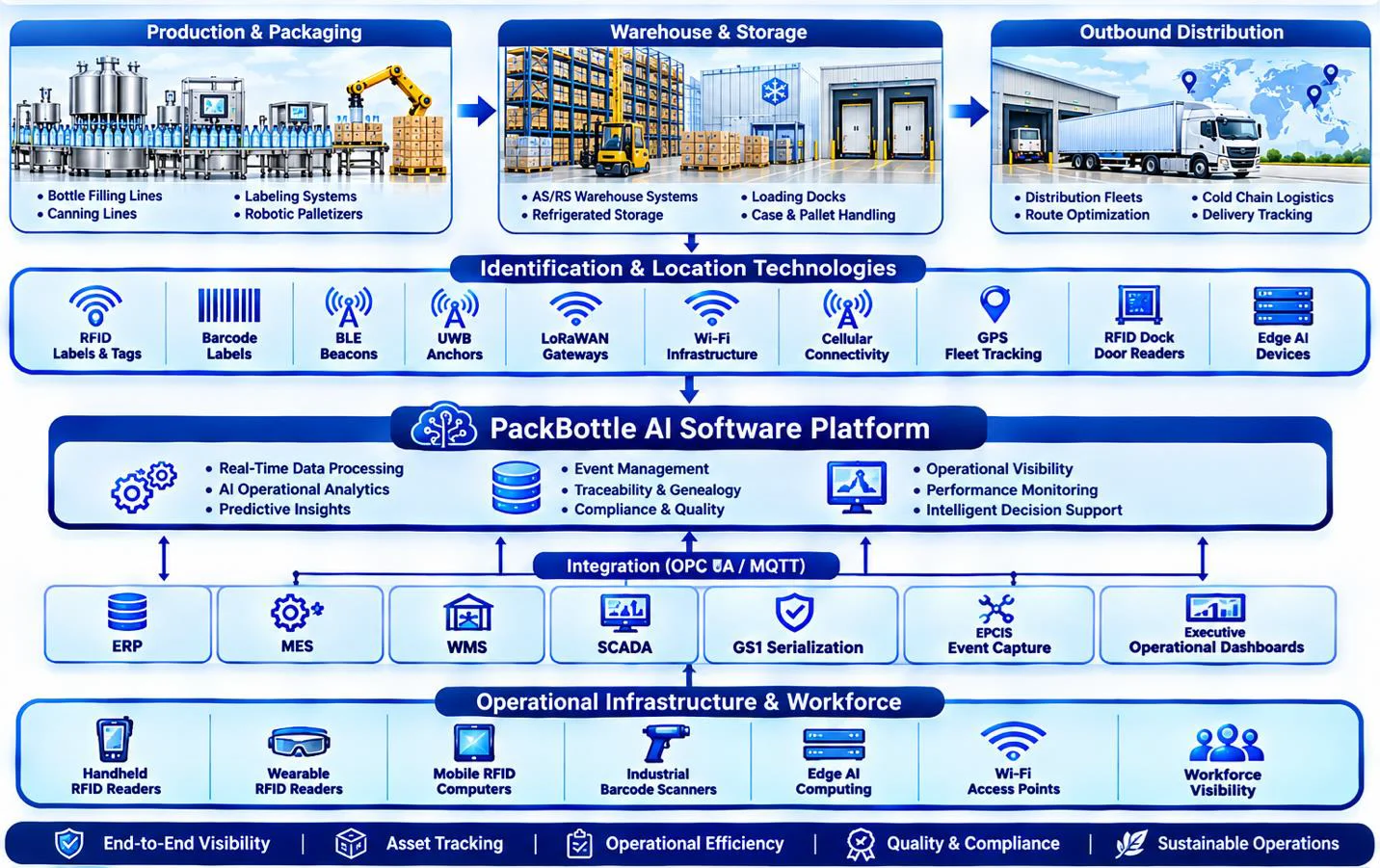
Industrial Identification Architecture for Beverage Packaging & Bottling Infrastructure
This architecture diagram illustrates how industrial identification and location technologies connect beverage packaging lines, warehouse operations, and outbound distribution through a unified AI-enabled platform. It shows RFID, barcode, BLE, UWB, LoRaWAN, Wi-Fi, GPS, and Edge AI devices capturing identification events that integrate with ERP, MES, WMS, SCADA, GS1 serialization, EPCIS event capture, and executive dashboards using OPC UA and MQTT. The architecture delivers end-to-end product visibility, asset tracking, warehouse execution, operational analytics, and real-time decision support across the packaging and bottling lifecycle.
AI and RFID for Packaging
RFID is the primary identification technology for automated packaging operations because it supports non-line-of-sight identification while reading multiple tagged items simultaneously. RFID significantly reduces manual scanning requirements across high-throughput production and warehouse environments.
Common RFID applications include:
- Bottle identification
- Case identification
- Pallet tracking
- Returnable crate management
- Keg identification
- Warehouse inventory
- Finished goods verification
- Dock door automation
- Shipping confirmation
- Production genealogy
- Asset identification
- Packaging material management
When combined with AI software, RFID identification events help improve:
- Warehouse productivity
- Inventory optimization
- Packaging throughput
- Asset utilization
- Production planning
- Distribution efficiency
- Product traceability
- Recall readiness
RFID technologies commonly deployed include passive UHF RFID, HF RFID, NFC, EPC-compliant RFID tags, and specialized on-metal RFID tags for reusable industrial assets.
AI and BLE for Bottling
Bluetooth Low Energy supports location visibility for personnel, forklifts, mobile packaging equipment, maintenance tools, AGVs, AMRs, and reusable operational assets throughout bottling facilities.
AI software analyzes BLE location history to identify:
- Equipment utilization trends
- Idle assets
- Workflow bottlenecks
- Asset movement frequency
- Production support efficiency
- Maintenance response times
- Workforce movement patterns
- Equipment availability
BLE provides an effective balance between deployment cost, infrastructure complexity, and operational visibility for mobile assets.
AI and UWB for Packaging Lines
Ultra-Wideband technology delivers highly accurate indoor positioning suitable for packaging operations requiring precise location awareness. UWB is especially valuable around automated production cells where forklifts, robotic palletizers, AGVs, AMRs, conveyors, and personnel operate simultaneously.
Representative applications include:
- Automated palletizing
- Robotic packaging cells
- AGV navigation
- AMR fleet coordination
- Forklift positioning
- Production cell coordination
- Restricted area verification
- Mobile equipment positioning
Major advantages include:
- Centimeter-level positioning accuracy
- Extremely low latency
- High location update frequency
- Reliable indoor performance
- Excellent support for industrial automation
- Improved operational coordination
Many manufacturers combine UWB with RFID to achieve both precise equipment positioning and automated product identification throughout packaging operations.
AI and LoRaWAN for Warehousing
Large beverage manufacturing campuses frequently include extensive warehouses, refrigerated storage facilities, returnable packaging yards, bulk material storage areas, and outdoor logistics operations. LoRaWAN extends communication across these large operational environments while requiring relatively little infrastructure.
Typical applications include:
- Warehouse identification
- Outdoor pallet yards
- Distribution campuses
- Returnable packaging storage
- Fleet staging areas
- Multi-building operations
- Remote storage facilities
- Cross-campus logistics
Operational advantages include:
- Long-distance communication
- Excellent warehouse coverage
- Reduced infrastructure investment
- Flexible expansion capability
- Reliable industrial communication
- Efficient campus-wide deployment
LoRaWAN complements RFID, BLE, and Wi-Fi by extending operational communication into locations where continuous wide-area coverage is required.
Bottling Connectivity Technologies
Industrial identification hardware requires a reliable communication foundation to transfer identification events from readers, gateways, handheld devices, mobile computers, and location infrastructure into enterprise software. Packaging and bottling operations depend on continuous communication because production lines frequently operate 24 hours a day with minimal planned downtime. Communication failures can interrupt inventory transactions, delay shipping verification, reduce production visibility, and affect traceability records.
A robust communication strategy should provide high availability, secure data transmission, low latency where required, and compatibility with existing manufacturing networks while supporting future production expansion.
Modern packaging facilities commonly combine Ethernet, industrial Wi-Fi, Cellular, GPS, and industrial messaging protocols such as OPC UA and MQTT to support continuous identification across production, warehousing, and distribution.
AI and Wi-Fi for Packaging
Industrial Wi-Fi provides high-speed wireless communication for mobile industrial devices throughout packaging and bottling facilities. It enables operators to perform inventory verification, warehouse transactions, shipping confirmation, production validation, and packaging material management without returning to fixed workstations.
Typical Wi-Fi-connected devices include:
- RFID handheld readers
- Mobile RFID computers
- Industrial barcode scanners
- Wearable RFID readers
- Vehicle-mounted terminals
- Forklift computers
- Quality inspection tablets
- Industrial HMIs
- Edge AI computers
Common deployment areas include:
- Bottle filling halls
- Capping and sealing lines
- Labeling operations
- Case packing areas
- Robotic palletizing cells
- Finished goods warehouses
- Refrigerated storage
- Shipping departments
- Maintenance workshops
Engineering considerations include:
- Predictive wireless coverage analysis
- RF site surveys
- Roaming optimization
- Channel planning
- Redundant access point placement
- VLAN segmentation
- WPA3 Enterprise security
- Quality of Service (QoS)
- Network redundancy
Properly designed industrial Wi-Fi infrastructure provides dependable connectivity while supporting thousands of identification transactions throughout daily production.
AI and Cellular for Beverage Logistics
Packaging operations continue beyond manufacturing facilities into regional warehouses, third-party logistics providers, customer distribution centers, and transportation fleets. Cellular communication provides secure wide-area connectivity for assets operating outside local facility networks.
Typical applications include:
- Fleet shipment verification
- Mobile warehouse operations
- Remote inventory reconciliation
- Distribution center communications
- Delivery confirmation
- Returnable crate recovery
- Mobile service operations
- Temporary warehouse deployments
Modern LTE and 5G connectivity supports real-time communication while reducing dependence on local wireless infrastructure.
Benefits include:
- Nationwide communication coverage
- High mobility
- Reliable connectivity
- Rapid deployment
- Secure remote communication
- Integration with enterprise software
AI and GPS for Distribution Fleets
GPS technology supports outdoor positioning for transportation operations involving bottled beverages, packaged food products, returnable containers, and warehouse transfers.
Packaging organizations commonly deploy GPS for:
- Beverage delivery fleets
- Trailer location
- Distribution planning
- Fleet dispatch
- Route verification
- Delivery scheduling
- Warehouse arrival estimation
- Returnable asset recovery
When integrated with AI software, GPS location history supports route optimization, fleet utilization analysis, delivery performance measurement, and logistics planning while improving customer service and transportation efficiency.
Hardware Selection Considerations
Selecting industrial IoT hardware for packaging and bottling operations requires balancing identification performance, production throughput, food safety requirements, integration objectives, and long-term maintainability. Hardware decisions should be based on engineering analysis rather than individual device specifications.
Critical evaluation criteria include:
- Packaging material characteristics
- Glass, PET, aluminum, corrugated, and reusable container compatibility
- Production throughput
- Conveyor speed
- Read accuracy requirements
- Read distance
- Tag orientation
- Metal and liquid interference
- Hygienic design requirements
- Washdown compatibility
- IP protection ratings
- Temperature operating range
- Cold storage compatibility
- Mechanical durability
- Battery life for active devices
- Enterprise software compatibility
- GS1 compliance
- EPC Gen2 compatibility
- EPCIS event support
- Cybersecurity requirements
- Device lifecycle management
- Firmware update capability
- Multi-site standardization
- Total cost of ownership
Most manufacturers benefit from combining several identification technologies rather than relying on a single technology throughout the facility.
A representative deployment strategy may include:
- RFID for pallet, case, RTI, and warehouse identification
- BLE for mobile asset visibility
- UWB for high-precision indoor positioning
- Barcode for regulatory labeling and customer compliance
- Wi-Fi for mobile industrial computing
- Cellular for transportation operations
- GPS for fleet visibility
Pilot deployments should validate read accuracy, infrastructure placement, software integration, and operational workflows before expanding to additional production lines or manufacturing facilities.
PackBottle AI was created within Aperture Venture Studio with support from GAO. Drawing upon more than two decades of industrial IoT experience, thousands of successful deployments, and extensive research and development, PackBottle AI helps manufacturers implement identification technologies that align with demanding packaging and bottling environments. Supported by rigorous quality assurance processes, experienced engineering teams, and Ph.D.-led technical leadership, the company has assisted Fortune 500 manufacturers, leading research institutions, prestigious universities, and government organizations throughout North America.
U.S. and Canadian Standards and Regulations
Packaging and bottling operations implementing AI-enabled workforce visibility, hygienic access control, packaging asset identification, inventory management, work-in-progress visibility, product traceability, and refrigerated logistics should evaluate applicable food safety, industrial automation, wireless communication, cybersecurity, and supply chain standards.
Relevant standards and regulations include:
- FDA Food Safety Modernization Act (FSMA)
- FDA 21 CFR Part 11
- FDA 21 CFR Part 117
- FDA Food Traceability Final Rule
- FDA Food Traceability List (FTL)
- Safe Food for Canadians Act (SFCA)
- Safe Food for Canadians Regulations (SFCR)
- Canadian Food Inspection Agency (CFIA) Regulations
- GS1 General Specifications
- GS1 EPC Tag Data Standard
- GS1 EPCIS Standard
- GS1 Core Business Vocabulary (CBV)
- GS1 Digital Link Standard
- GS1-128
- GS1 DataMatrix
- Serial Shipping Container Code (SSCC)
- ISO 22000
- FSSC 22000
- HACCP
- SQF Food Safety Code
- BRCGS Global Food Safety Standard
- GFSI Benchmarking Requirements
- ISO/IEC 18000 Series
- ISO/IEC 18046
- ISO/IEC 18047
- ISO/IEC 29167
- ISO 17363
- ISO 17364
- ISO 17365
- ISO 17366
- ISA-95
- IEC 62443
- IEC 62541 (OPC UA)
- MQTT
- IEEE 802.11
- Bluetooth Core Specification
- NFC Forum Specifications
- NIST Cybersecurity Framework (CSF)
- NIST SP 800-82
- ISO/IEC 27001
- SOC 2
- OSHA 29 CFR 1910
- ANSI/RIA R15.06
- CSA Z432
- CTPAT Minimum Security Criteria
Top Industry Players Supporting AI and IoT-Enabled Packaging & Bottling Operations
Packaging and bottling operations rely on a combination of industrial identification hardware, wireless communications, industrial mobile computing, packaging automation, enterprise software, machine vision, and systems integration. Rather than depending on a single supplier, most food and beverage manufacturers deploy interoperable technologies that support bottle filling, canning, labeling, case packing, palletizing, warehouse logistics, inventory control, product traceability, and beverage distribution.
The following companies are recognized across North America and globally for technologies commonly used in Packaging & Bottling Operations.
Industrial RFID and Automatic Identification
These organizations provide RFID tags, RFID readers, RFID printers, RFID encoding, industrial identification software, dock door portals, handheld RFID readers, and automatic identification technologies widely deployed throughout packaging and bottling facilities.
- Zebra Technologies
- Impinj
- HID Global
- Avery Dennison
- SATO
- Checkpoint Systems
- GAO RFID Inc.
- Beontag
- Tageos
- Xerafy
- Confidex
- Identiv
- Alien Technology
- CAEN RFID
- Nordic ID
- Pepperl+Fuchs
- Balluff
- Turck
- Siemens
- ifm
Industrial Barcode and Labeling Technologies
Industrial barcode technologies remain fundamental for packaging and bottling operations because GS1-compliant identification supports warehouse operations, retail distribution, logistics, and regulatory traceability.
Major providers include:
- Zebra Technologies
- Honeywell
- SATO
- TSC Auto ID
- Toshiba Tec
- Brother Industrial Solutions
- Brady Corporation
- Epson ColorWorks
- CAB Produkttechnik
- Markem-Imaje
- Domino Printing Sciences
- Videojet Technologies
- Matthews Marking Systems
- Leibinger
Typical applications include:
- GS1-128 labeling
- GS1 DataMatrix identification
- SSCC pallet labels
- Carton identification
- Case labeling
- Warehouse labeling
- Shipping labels
- Product serialization
- Compliance labeling
- Distribution labeling
BLE Location Technologies
Bluetooth Low Energy supports personnel identification, warehouse asset visibility, forklift location, maintenance operations, and returnable packaging management.
Leading providers include:
- Kontakt.io
- BlueCats
- Minew
- HID Global
- Quuppa
- Cisco Spaces
- HPE Aruba Networking
- Litum
- Siemens
- GAO Tek Inc.
Representative applications include:
- Workforce identification
- Maintenance staff visibility
- Warehouse personnel coordination
- Forklift identification
- Mobile packaging cart location
- Tool identification
- Contractor management
- Visitor identification
Ultra-Wideband Positioning
Ultra-Wideband technologies deliver high-accuracy indoor positioning for automated packaging facilities, robotic palletizing cells, warehouse automation, and high-value production assets.
Leading suppliers include:
- Qorvo
- Sewio Networks
- Ubisense
- Zebra Technologies
- Litum
- Kinexon
- Pozyx
- BeSpoon
- Siemens
- Inpixon
Typical applications include:
- AGV coordination
- AMR navigation
- Forklift positioning
- Robotic palletizing
- Mobile production equipment
- High-value tooling identification
- Automated warehouse operations
- Personnel location
Industrial Mobile Computing
Rugged mobile computers enable production personnel, warehouse operators, inventory specialists, and maintenance technicians to perform mobile identification activities throughout packaging and bottling facilities.
Major providers include:
- Zebra Technologies
- Honeywell
- Datalogic
- CipherLab
- Bluebird
- Newland AIDC
- Unitech
- Panasonic Toughbook
- Getac
- Advantech
Representative devices include:
- RFID handheld readers
- Rugged barcode scanners
- Wearable RFID readers
- Vehicle-mounted computers
- Industrial tablets
- Mobile RFID computers
Industrial Wireless Communications
Reliable industrial communications provide the connectivity required for AI and IoT identification systems throughout production facilities, warehouses, refrigerated storage, and distribution centers.
Major suppliers include:
- Cisco
- HPE Aruba Networking
- Juniper Networks
- Extreme Networks
- Siemens
- Phoenix Contact
- Belden
- Moxa
- Hirschmann
- Fortinet
Common technologies include:
- Industrial Ethernet
- Wi-Fi 6
- Wi-Fi 6E
- Private LTE
- 5G
- Bluetooth Low Energy
- LoRaWAN
- OPC UA
- MQTT
Enterprise Software
Enterprise software integrates identification events with production operations, warehouse management, inventory control, quality documentation, shipping, and business processes.
Major providers include:
- SAP
- Oracle
- Microsoft
- Infor
- Körber Supply Chain
- Manhattan Associates
- Blue Yonder
- Epicor
- Oracle NetSuite
- Tecsys
Typical integrations include:
- ERP
- MES
- WMS
- SCM
- Production scheduling
- Warehouse management
- Inventory management
- Distribution planning
- Shipping management
Packaging and Bottling Equipment Manufacturers
Packaging equipment manufacturers increasingly integrate RFID, industrial barcode, machine vision, AI software, and industrial automation into modern production lines.
Major suppliers include:
- Krones
- Sidel
- KHS Group
- Tetra Pak
- GEA Group
- Syntegon
- Coesia
- ProMach
- Barry-Wehmiller
- SACMI
- BW Packaging
- Marchesini Group
Representative equipment includes:
- Bottle filling systems
- Can filling systems
- Bottle rinsers
- Capping machines
- Labeling machines
- Cartoners
- Case packers
- Robotic palletizers
- Stretch wrappers
- Conveyors
- Depalletizers
- Pallet handling systems
Machine Vision and Automatic Identification
Machine vision complements RFID and barcode identification by validating labels, verifying serialization, inspecting packaging quality, and supporting automated production verification.
Leading providers include:
- Cognex
- Keyence
- Omron
- SICK
- Teledyne FLIR
- Basler
- Zebra Technologies
- Datalogic
- MVTec Software
- Matrox Imaging
Representative applications include:
- Barcode verification
- GS1 DataMatrix verification
- OCR verification
- Product serialization
- Label inspection
- Print quality verification
- Carton inspection
- Case verification
- Packaging validation
- Production quality documentation
U.S. Case Studies
Chicago, Illinois AI and IoT Workforce Visibility and Hygienic Access Control for a Multi-Line Beverage Packaging Facility
Background
A large beverage packaging and bottling operation in Chicago operated multiple high-speed PET bottle, glass bottle, and aluminum can packaging lines supplying regional distribution centers throughout the Midwest. The facility included bottle depalletizing, rinsing, filling, capping, labeling, case packing, robotic palletizing, warehouse staging, refrigerated finished goods storage, and outbound shipping.
Several hundred production employees, maintenance technicians, sanitation personnel, quality assurance staff, warehouse operators, forklift drivers, temporary workers, and contractors worked across multiple shifts. Manual workforce verification and conventional badge systems limited operational visibility, particularly within hygienic production zones where access authorization, personnel accountability, and emergency mustering were critical.
PackBottle AI, drawing upon implementation experience from GAO, GAO Tek Inc., and GAO RFID Inc., designed and deployed an enterprise AI and IoT identification solution focused on workforce visibility and hygienic access management while integrating with existing manufacturing software and warehouse operations.
Problem
The organization identified several operational challenges:
- Limited real-time visibility of production personnel across filling, labeling, packaging, palletizing, and warehouse operations.
- Manual verification of employee and contractor access to hygienic production areas.
- Time-consuming emergency evacuation accountability during scheduled drills.
- Difficulty correlating personnel movement with production activities and maintenance work orders.
- Manual reporting of shift attendance and workforce allocation.
- Limited visibility of contractor access history for food safety audits.
- Inconsistent documentation supporting regulatory compliance and internal operating procedures.
Solution
PackBottle AI implemented an AI and IoT workforce identification solution centered on secure identification rather than environmental monitoring.
The deployment incorporated multiple GAO technology categories, including:
- GAO RFID UHF Readers
- GAO RFID UHF Tags
- GAO RFID RFID Antennas
- GAO RFID BLE Gateways
- GAO RFID BLE Beacons
- GAO Tek BLE & RFID hardware
- GAO Tek Edge Computing devices
- GAO Tek Biometric Devices for controlled production entrances
Personnel received RFID-enabled identification credentials, while BLE badges supported workforce location awareness within designated production and warehouse areas. Fixed RFID readers were installed at production entrances, warehouse transition points, hygienic filling rooms, maintenance workshops, and finished goods staging locations.
BLE gateways collected location events throughout packaging operations while Edge AI software analyzed identification events to improve workforce visibility without requiring continuous manual supervision.
The solution integrated with:
- ERP software
- MES software
- Warehouse Management Software
- Shift scheduling software
- Electronic access management software
- Emergency mustering software
AI software automatically correlated identification events with production schedules, maintenance activities, sanitation windows, and authorized work assignments. Authorized personnel received access to restricted production areas based upon operational roles, while contractor credentials remained active only during approved work periods.
Warehouse supervisors obtained improved visibility of forklift operators, maintenance personnel, and sanitation teams moving between packaging cells and warehouse staging areas.
Emergency response teams could verify personnel accountability using automated identification records rather than manual roll calls.
Result
The deployment enabled measurable operational improvements, including:
- Emergency mustering completed in less than 5 minutes during scheduled drills.
- Reduced manual workforce verification activities.
- Improved compliance documentation for hygienic production areas.
- Faster contractor authorization validation.
- Improved production workforce coordination across multiple packaging lines.
- Better visibility of maintenance personnel supporting production equipment.
- More accurate electronic attendance reporting.
The most significant measurable outcome was reducing scheduled emergency accountability time to under five minutes, allowing production supervisors to account for personnel more efficiently during evacuation exercises.
Lesson Learned
Accurate workforce identification depends on careful placement of RFID readers, BLE gateways, and access points. Early RF site surveys, phased commissioning, and coordination with production supervisors minimized identification blind spots and reduced operational disruption during deployment.
Fresno, California AI and RFID Packaging Asset Identification and Warehouse Inventory Optimization for Beverage Bottling Operations
Background
A beverage bottling facility serving western U.S. markets managed thousands of reusable operational assets supporting bottle filling, labeling, cartoning, palletizing, warehouse logistics, and outbound distribution. Assets included returnable plastic crates, pallets, stainless steel kegs, mobile packaging carts, forklifts, pallet jacks, change parts, maintenance tooling, and warehouse handling equipment.
Manual asset identification required significant labor, while misplaced returnable transport items occasionally delayed production scheduling and warehouse operations.
Leveraging implementation knowledge developed through GAO, GAO Tek Inc., and GAO RFID Inc., PackBottle AI deployed an AI and RFID asset identification and warehouse inventory solution designed specifically for packaging and bottling operations.
Problem
Operational challenges included:
- Limited visibility of reusable packaging assets.
- Manual searches for pallets, returnable crates, and mobile equipment.
- Inventory reconciliation requiring significant labor.
- Delayed production caused by unavailable change parts.
- Inconsistent warehouse asset records.
- Difficulty tracking packaging equipment transferred between production areas.
- Limited visibility of finished goods movement into warehouse staging.
Solution
PackBottle AI implemented an AI and IoT identification system emphasizing RFID-based asset identification throughout production and warehouse operations.
The deployment incorporated hardware from relevant GAO technology categories, including:
- GAO RFID UHF Readers
- GAO RFID UHF Tags
- GAO RFID RFID Reader Modules
- GAO RFID RFID Antennas
- GAO Tek UHF RFID Readers
- GAO Tek Tags and Accessories
- GAO Tek BLE Gateways
- GAO Tek Industrial Edge Computing devices
- GAO Tek GPS IoT Trackers for logistics assets
- GAO Tek Cellular IoT Devices supporting distribution visibility
RFID tags were attached to returnable crates, pallets, mobile packaging carts, maintenance equipment, warehouse handling assets, and reusable transport containers. Fixed RFID readers captured identification events at dock doors, warehouse entrances, palletizing cells, finished goods staging areas, and shipping lanes.
Warehouse operators used handheld RFID readers to perform rapid inventory verification, locate mobile assets, and reconcile warehouse inventory. BLE location services supplemented RFID identification within selected warehouse areas where continuous asset visibility improved operational efficiency.
AI software analyzed identification records to identify underutilized assets, repetitive movement patterns, and prolonged idle times. Integration with ERP, MES, and WMS software synchronized identification events with production orders, warehouse transactions, inventory records, and shipping documentation.
Distribution personnel also benefited from GPS-enabled logistics visibility for selected reusable transportation assets operating between manufacturing sites and regional distribution facilities.
Result
The project produced several operational improvements:
- Warehouse inventory verification completed significantly faster than previous manual methods.
- Improved visibility of returnable packaging assets.
- Reduced time locating mobile production equipment.
- Better warehouse inventory accuracy.
- Improved pallet movement documentation.
- Faster reconciliation of reusable transport items.
- Better utilization of warehouse handling equipment.
The most important measurable result was a substantial reduction in warehouse inventory verification time, enabling warehouse teams to complete scheduled inventory reconciliation during normal operating windows without interrupting production activities.
Lesson Learned
Successful RFID asset identification depends on selecting tag designs appropriate for plastic crates, corrugated packaging, metal kegs, and mixed-material reusable assets. Pilot validation under actual packaging line conditions helped optimize reader placement, antenna orientation, and identification reliability before full-scale deployment.
Atlanta, Georgia AI and IoT Product Traceability, Work-in-Progress Visibility, and Cold Chain Identification for Beverage Packaging & Bottling Operations
Background
A large beverage packaging and bottling operation in Atlanta managed multiple high-speed PET bottle, aluminum can, and glass bottle production lines supplying supermarkets, food service distributors, convenience stores, and regional beverage distribution centers throughout the southeastern United States. Operations included bottle blowing, rinsing, filling, capping, labeling, cartoning, shrink wrapping, robotic palletizing, cold beverage warehousing, refrigerated staging, and outbound logistics.
The organization required improved visibility of packaging work-in-progress, pallet identification, bottle serialization, lot genealogy, warehouse inventory, and refrigerated finished goods movement while maintaining compliance with food safety and traceability requirements.
PackBottle AI leveraged implementation experience developed through GAO, GAO Tek Inc., and GAO RFID Inc. to design an enterprise AI and IoT identification solution emphasizing RFID, BLE, industrial barcode, Edge AI, and location technologies rather than conventional manual identification processes.
Problem
Production managers identified several operational issues:
- Limited visibility of packaging work-in-progress moving between production cells.
- Manual verification of serialized cases and pallet labels.
- Delays locating finished pallets awaiting shipment.
- Time-consuming product genealogy investigations during internal quality reviews.
- Limited identification history for refrigerated warehouse movements.
- Manual reconciliation between packaging operations and warehouse transactions.
- Reduced visibility of production bottlenecks caused by pallet accumulation.
Solution
PackBottle AI implemented an AI and RFID and AI and BLE identification solution integrating production identification with warehouse logistics.
The deployment incorporated hardware from GAO technology categories, including:
- GAO RFID UHF Readers
- GAO RFID UHF Tags
- GAO RFID RFID Antennas
- GAO RFID RFID Reader Modules
- GAO RFID BLE Gateways
- GAO RFID BLE Beacons
- GAO Tek UHF RFID Readers
- GAO Tek BLE & RFID hardware
- GAO Tek Edge Computing devices
- GAO Tek Cellular IoT Devices
- GAO Tek GPS IoT Trackers supporting regional distribution visibility
RFID identification points were installed at bottle packaging lines, case packers, pallet wrappers, warehouse transfer lanes, dock doors, refrigerated storage areas, and shipping verification stations. BLE location technology supplemented pallet movement visibility within warehouse staging locations where fixed RFID coverage alone was insufficient.
Industrial barcode identification continued supporting bottle serialization while RFID automated pallet identification and warehouse transfers. AI software correlated identification events with MES production records, ERP transactions, warehouse inventory, shipment documentation, and product genealogy records.
Edge AI software analyzed movement history to identify repetitive pallet dwell patterns, excessive warehouse transfers, production queue accumulation, and delayed shipment preparation. GPS-enabled logistics devices supported visibility for selected outbound transportation assets operating between manufacturing plants and regional distribution centers.
The solution integrated with:
- ERP software
- MES software
- WMS software
- SCADA software
- Quality Management Software
- Transportation Management Software
The combined AI and IoT solution established a continuous identification record from finished packaging through warehouse storage and outbound shipment while preserving complete traceability information.
Result
Operational improvements included:
- Improved visibility of packaging work-in-progress.
- Faster identification of finished pallets.
- Improved warehouse inventory synchronization.
- Better product genealogy documentation.
- Reduced manual reconciliation between manufacturing and warehouse software.
- Improved shipment verification.
- Faster internal product traceability investigations.
The most significant measurable outcome was a substantial reduction in internal product genealogy lookup time, enabling production and quality teams to retrieve complete identification records significantly faster than previous manual processes.
Lesson Learned
Successful traceability projects require standardized identification rules across production, warehouse, and distribution operations. Consistent RFID tag commissioning, serialization procedures, and ERP-MES-WMS integration significantly reduce reconciliation exceptions while improving long-term data quality.
Canadian Case Studies
Mississauga, Ontario AI and IoT Workforce, Packaging Asset, and Warehouse Identification for Multi-Plant Beverage Packaging Operations
Background
A beverage manufacturer operating multiple packaging and bottling facilities in Ontario sought to standardize workforce identification, packaging asset visibility, warehouse inventory management, and interfacility logistics. Production included bottled beverages, canned beverages, secondary packaging, case packing, robotic palletizing, refrigerated warehouse operations, and regional distribution.
The organization required an enterprise AI and IoT solution capable of improving personnel accountability, hygienic access verification, returnable asset identification, warehouse inventory accuracy, and pallet movement visibility while integrating with existing manufacturing software.
Drawing upon practical deployment experience from GAO, GAO Tek Inc., and GAO RFID Inc., PackBottle AI designed a phased identification solution using RFID, BLE, Wi-Fi, Cellular, GPS, and Edge AI technologies.
Problem
Operational assessments identified several priorities:
- Limited visibility of personnel working across multiple production areas.
- Manual access verification for hygienic bottling zones.
- Difficulty locating reusable packaging assets between facilities.
- Manual warehouse inventory reconciliation.
- Limited visibility of forklift activity supporting pallet movement.
- Inconsistent identification procedures across multiple production locations.
- Delays locating reusable transport containers during interfacility transfers.
Solution
PackBottle AI implemented a phased enterprise AI and IoT identification system emphasizing workforce identification, access control, packaging asset tracking, warehouse inventory management, and logistics visibility.
Hardware deployed from GAO technology categories included:
- GAO RFID BLE Gateways
- GAO RFID BLE Beacons
- GAO RFID UHF Readers
- GAO RFID UHF Tags
- GAO RFID RFID Accessories
- GAO Tek BLE & RFID hardware
- GAO Tek Cellular IoT Devices
- GAO Tek GPS IoT Trackers
- GAO Tek Edge Computing devices
- GAO Tek Biometric Devices for controlled production entry
Personnel received RFID and BLE identification credentials supporting workforce accountability and controlled access to bottling, filling, sanitation, maintenance, warehouse, and packaging operations.
Reusable pallets, returnable crates, mobile packaging equipment, forklifts, maintenance carts, and warehouse assets received UHF RFID identification. Fixed readers were installed at production entrances, warehouse transfer points, dock doors, staging areas, and interfacility shipping locations.
BLE gateways improved personnel and mobile asset visibility within selected operational zones. GPS tracking devices supported transportation visibility for reusable logistics equipment operating between manufacturing facilities and regional warehouses.
Edge AI software analyzed identification records to improve labor allocation, asset utilization, warehouse workflow coordination, and logistics planning while integrating with ERP, MES, WMS, and electronic access management software.
Our engineering teams from GAO Tek Inc. and GAO RFID Inc. supported RF planning, reader configuration, BLE gateway placement, software integration, pilot validation, user training, and phased commissioning. Throughout implementation, we emphasized scalable identification practices that could be replicated across additional production facilities without disrupting ongoing packaging operations.
Result
The deployment achieved several operational improvements:
- Improved workforce accountability across multiple facilities.
- Faster verification of hygienic access authorization.
- Better visibility of reusable packaging assets.
- Improved warehouse inventory consistency.
- Reduced manual identification activities.
- Improved interfacility pallet tracking.
- Better coordination between production and warehouse operations.
The most important measurable outcome was a significant reduction in the time required to locate reusable packaging assets during interfacility transfers, improving logistics planning and reducing production delays caused by unavailable returnable transport equipment.
Lesson Learned
Enterprise identification solutions should begin with standardized RFID data structures, common access policies, and consistent operational procedures before expanding across multiple manufacturing sites. Standardization simplifies software integration, improves reporting consistency, and reduces long-term maintenance requirements while supporting future expansion of AI and IoT capabilities across packaging and bottling operations.
Why PackBottle AI
PackBottle AI specializes in AI and IoT identification and location solutions designed specifically for packaging and bottling operations within the Food & Beverage Manufacturing Industry. Our solutions are engineered to improve operational visibility across bottle filling, labeling, cartoning, palletizing, warehousing, cold storage, and beverage distribution while supporting food safety, regulatory compliance, and supply chain traceability.
Rather than promoting generic technology, we focus on practical engineering, standards-based integration, and proven deployment methodologies. Our teams evaluate production workflows, packaging formats, warehouse operations, communication infrastructure, and enterprise software to recommend identification technologies aligned with each manufacturer's operational objectives.
Built within Aperture Venture Studio with support from GAO, PackBottle AI benefits from more than twenty years of industrial IoT experience, thousands of completed customer projects, extensive research and development, rigorous quality assurance, and expert technical support delivered remotely or onsite. Our engineering organization includes Ph.D.-led specialists with deep expertise in industrial RFID, wireless communications, enterprise software integration, and food and beverage manufacturing operations. Over the years, our experience has supported Fortune 500 companies, leading research organizations, prestigious universities, and government agencies across the United States and Canada.
Contact PackBottle AI
Whether your organization is upgrading a single packaging line, expanding warehouse capacity, implementing GS1 serialization, improving returnable transport item management, modernizing beverage distribution, or deploying enterprise-wide AI and IoT identification solutions, PackBottle AI can help develop an implementation strategy aligned with your operational goals.
Our engineering specialists assist manufacturers with:
- RFID solution design
- BLE location systems
- UWB positioning solutions
- Barcode modernization
- Warehouse identification strategies
- Bottle serialization
- GS1 and EPCIS implementation
- Returnable packaging management
- ERP, MES, WMS, and SCADA integration
- Multi-site deployment planning
- Industrial wireless infrastructure design
- AI and IoT implementation roadmaps
Modernize Packaging & Bottling Operations with Enterprise AI and IoT Hardware
Improve workforce visibility, packaging asset identification, warehouse inventory accuracy, bottle serialization, pallet traceability, GS1 compliance, EPCIS event capture, returnable transport item management, and beverage distribution using industrial RFID, BLE, UWB, barcode, LoRaWAN, Wi-Fi, Cellular, GPS, and NFC technologies. Contact PackBottle AI to discuss an AIoT hardware solution engineered specifically for packaging and bottling operations within the Food & Beverage Manufacturing Industry.