
Integrate AI and IoT software with ERP, MES, WMS, SCADA, RFID, BLE, UWB, OPC UA, MQTT, Edge AI, cloud, and on-premises systems for food and beverage packaging and bottling operations.
Improve bottle serialization, lot genealogy, packaging material traceability, pallet tracking, warehouse visibility, returnable asset management, and beverage distribution.
Enterprise AI and IoT Integration for Food & Beverage Packaging & Bottling Operations
Food and beverage packaging and bottling facilities rely on tightly coordinated manufacturing, packaging, warehousing, and distribution processes where thousands of bottles, cans, cartons, cases, pallets, and returnable transport items move through automated production lines every hour. Maintaining product quality, food safety, production efficiency, and regulatory compliance requires continuous coordination between enterprise manufacturing software, industrial identification technologies, warehouse operations, and packaging equipment.
PackBottle AI delivers enterprise AI and IoT integration solutions specifically designed for packaging and bottling operations. Our software connects ERP, MES, WMS, SCADA, RFID infrastructure, BLE location services, industrial barcode systems, OPC UA communication, MQTT messaging, Edge AI processing, cloud environments, and on-premises manufacturing systems into a unified operational environment.
Rather than replacing existing manufacturing investments, PackBottle AI extends enterprise software by integrating industrial identification and location technologies throughout bottle filling, canning, rinsing, capping, crowning, labeling, shrink sleeve application, laser coding, inkjet coding, cartoning, wrap-around case packing, tray packing, robotic palletizing, warehouse logistics, and beverage distribution. This connected approach improves operational visibility, packaging traceability, inventory accuracy, returnable asset utilization, and production coordination while minimizing manual data collection.
Integration for Packaging & Bottling Operations Overview
Packaging and bottling facilities represent some of the most automated manufacturing environments within the food and beverage industry. High-speed fillers, bottle rinsers, cappers, crowners, label applicators, laser coders, vision inspection systems, case packers, palletizers, automated storage systems, and warehouse operations must function together as a synchronized production process.
Every production shift generates millions of operational events involving bottles, cans, labels, closures, cartons, pallets, returnable transport items, packaging materials, finished goods, warehouse movements, and outbound shipments. Managing these activities efficiently requires reliable integration between enterprise software and industrial identification technologies.
AI and IoT integration enables manufacturing systems to exchange verified operational information automatically rather than relying on manual recording or disconnected software applications. RFID identification, BLE location technologies, UWB positioning where high positional accuracy is required, industrial barcode systems, mobile RFID computers, wearable RFID readers, and enterprise manufacturing software work together to improve operational visibility throughout the packaging lifecycle.
Unlike general-purpose manufacturing integration, packaging and bottling operations demand specialized connectivity because production depends on continuous high-speed material flow, strict batch control, packaging material accountability, bottle serialization, pallet identification, warehouse synchronization, and distribution traceability. Every identified object, whether an individual bottle, a production batch, a finished pallet, or a reusable crate, contributes to maintaining an accurate digital production history.
Typical enterprise systems integrated with PackBottle AI include:
- Enterprise Resource Planning (ERP)
- Manufacturing Execution Systems (MES)
- Warehouse Management Systems (WMS)
- Supervisory Control and Data Acquisition (SCADA)
- Warehouse Control Systems (WCS)
- RFID identification systems
- BLE real-time location systems
- UWB positioning systems
- Industrial barcode systems
- OPC UA communication
- MQTT messaging
- RESTful APIs
- Edge AI processing
- Cloud software
- On-premises manufacturing servers
- Enterprise reporting systems
These connected systems exchange production events continuously across filling operations, packaging lines, warehouse logistics, pallet staging, cold storage facilities, and beverage distribution centers. The result is a synchronized manufacturing environment where identification events automatically update production records, warehouse inventories, shipment documentation, and enterprise reporting systems.
Packaging operations frequently process multiple stock keeping units (SKUs), container sizes, label versions, promotional packaging formats, and seasonal production campaigns simultaneously. AI and IoT integration helps coordinate these production activities while maintaining accurate batch genealogy, packaging material consumption records, serialization data, and warehouse inventory balances.
Food safety and regulatory compliance add another layer of complexity. Beverage manufacturers must maintain complete traceability from packaging material receipt through bottle filling, labeling, palletization, warehouse storage, shipment, and customer delivery. AI and IoT software supports these requirements by preserving electronic production records, GS1 serialization data, SSCC pallet identifiers, lot genealogy, packaging history, and distribution records.
Warehouse operations similarly benefit from integrated identification systems. Finished pallets entering automated storage areas can be associated with production batches, warehouse locations, customer orders, FEFO inventory strategies, and outbound shipment schedules. This reduces manual inventory transactions while improving warehouse accuracy and shipping verification.
Returnable transport items such as reusable beverage crates, plastic pallets, stainless steel containers, reusable kegs, and transport totes represent valuable operational assets that circulate continuously among production facilities, distribution centers, retailers, and customers. AI and IoT software improves visibility throughout the lifecycle of these assets, helping manufacturers reduce losses, optimize asset utilization, and improve return logistics.
Packaging material management is another critical integration area. Closures, caps, crowns, labels, shrink sleeves, adhesives, corrugated cases, trays, stretch film, and pallets can all be associated with specific production batches, supporting complete packaging genealogy while simplifying quality investigations and product recall procedures.
For manufacturers operating multiple production plants, standardized AI and IoT integration simplifies enterprise reporting, production planning, inventory reconciliation, warehouse coordination, and corporate governance while maintaining consistent operational practices across facilities.
Enterprise AI + IoT Integration Architecture for Food & Beverage Packaging Operations
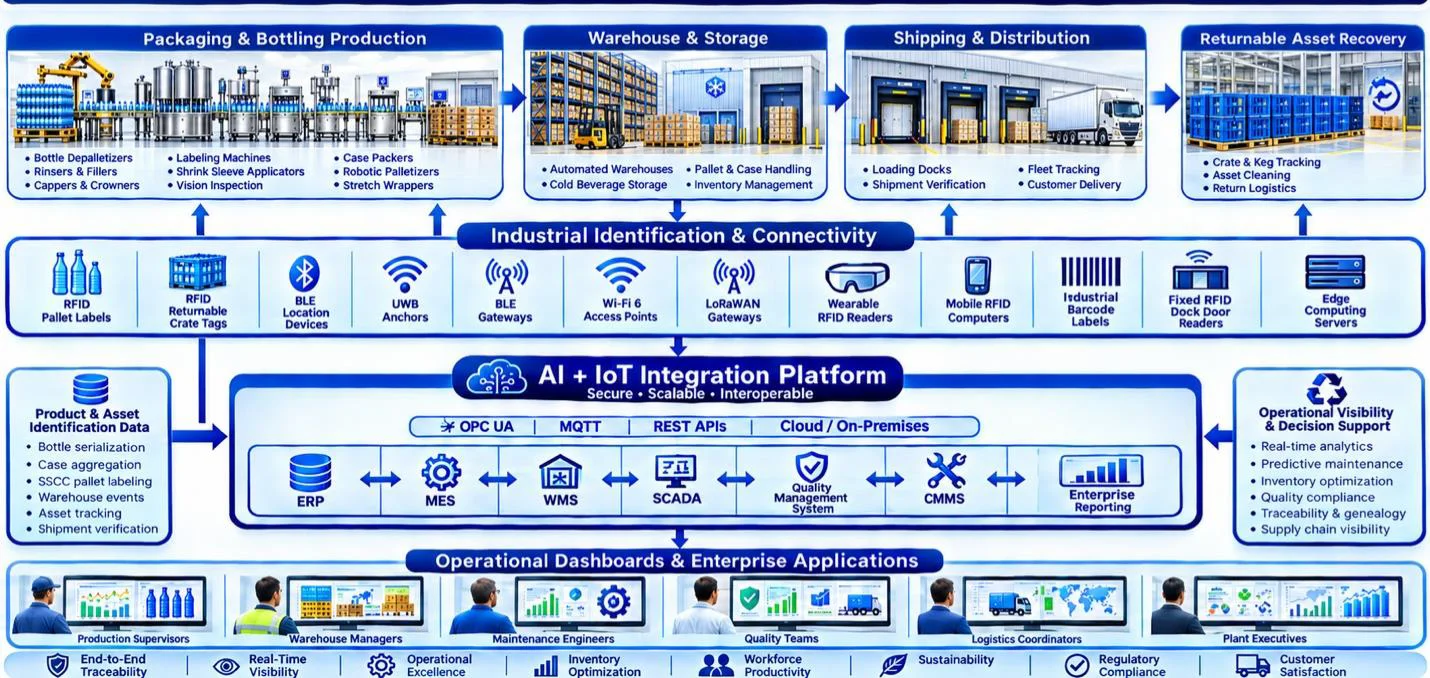
This enterprise architecture diagram illustrates how AI and IoT technologies integrate packaging production, warehouse operations, shipping, and returnable asset recovery into a unified digital manufacturing platform. It shows industrial identification technologies—including RFID, BLE, UWB, barcode, Wi-Fi 6, LoRaWAN, and Edge AI—capturing operational events that flow through secure OPC UA, MQTT, REST API, cloud, and on-premises integrations with ERP, MES, WMS, SCADA, Quality Management, CMMS, and enterprise reporting systems. The architecture enables bottle serialization, case aggregation, SSCC pallet labeling, warehouse execution, shipment verification, returnable asset tracking, and enterprise-wide operational visibility with real-time analytics and end-to-end traceability.
Why Enterprise AI and IoT Integration Is Essential for Packaging & Bottling
Modern packaging lines routinely operate at speeds exceeding hundreds or even thousands of bottles or cans per minute. Manual information collection cannot reliably support these production rates while maintaining the accuracy required for food safety, inventory management, warehouse operations, and regulatory compliance.
Enterprise AI and IoT integration enables packaging facilities to:
- Improve bottle serialization and GS1 compliance.
- Strengthen case-level and pallet-level traceability.
- Synchronize ERP, MES, WMS, and SCADA records automatically.
- Improve packaging material accountability.
- Optimize returnable transport item utilization.
- Improve warehouse inventory accuracy using RFID identification.
- Support FEFO inventory management.
- Reduce manual production reporting.
- Maintain electronic batch records.
- Improve beverage distribution visibility.
- Simplify regulatory documentation.
- Improve multi-site production coordination.
- Increase operational transparency throughout packaging and bottling workflows.
Rather than replacing existing manufacturing software, PackBottle AI extends enterprise manufacturing systems using proven AI and IoT technologies focused on industrial identification, asset location, production traceability, and warehouse coordination.
Packaging ERP Integration
Enterprise Resource Planning (ERP) systems serve as the operational backbone of food and beverage manufacturing by coordinating production planning, procurement, inventory management, warehouse operations, quality documentation, maintenance planning, financial reporting, customer order fulfillment, and supply chain activities. Within packaging and bottling operations, ERP integration becomes particularly important because high-speed production lines continuously consume packaging materials while producing large volumes of finished goods that must be accurately tracked from production through distribution.
PackBottle AI integrates AI and IoT software with ERP systems by automatically exchanging verified operational events generated through RFID identification, BLE location technologies, industrial barcode systems, and Edge AI processing. Rather than relying on manual operator transactions, packaging activities are automatically synchronized with enterprise records, improving data accuracy while reducing administrative workload.
Typical ERP information exchanged during packaging operations includes:
- Production order execution
- Packaging work order status
- Finished goods confirmation
- Bottle serialization records
- Packaging material consumption
- Label usage verification
- Closure and cap inventory updates
- Pallet creation records
- Returnable transport item movements
- Warehouse inventory transactions
- Shipment preparation
- Customer order fulfillment
- Product genealogy records
- Batch completion status
This automated synchronization enables production managers, warehouse supervisors, quality engineers, and supply chain planners to work from a consistent operational dataset across the manufacturing enterprise.
Packaging Material Management
Packaging materials represent a significant portion of manufacturing costs and directly influence product quality, regulatory compliance, and production efficiency. Beverage packaging facilities consume numerous materials including:
- PET preforms
- Glass bottles
- Aluminum cans
- Closures
- Crown caps
- Plastic caps
- Labels
- Shrink sleeves
- Corrugated cartons
- Wrap-around cases
- Trays
- Stretch film
- Adhesives
- Pallets
- Returnable crates
AI and IoT software exchanges packaging material transactions with ERP software to maintain accurate inventory balances throughout production. RFID identification and barcode verification ensure that materials issued to packaging lines are correctly associated with production orders, reducing inventory discrepancies and supporting complete lot genealogy.
Benefits include:
- Improved material accountability
- Reduced inventory variance
- Automated consumption reporting
- Improved replenishment planning
- Better supplier traceability
- More accurate production costing
- Simplified inventory audits
Production Order Synchronization
Packaging facilities frequently operate multiple filling lines simultaneously, producing different beverages, container sizes, packaging formats, and promotional products. AI and IoT integration synchronizes ERP production orders with manufacturing execution activities, allowing production schedules to remain aligned with actual packaging operations.
Production synchronization supports:
- Filling order execution
- Packaging schedule management
- SKU changeovers
- Recipe transitions
- Bottle format changes
- Label version management
- Shift production reporting
- Production quantity reconciliation
- Packaging completion confirmation
Automatic synchronization reduces duplicate data entry while improving coordination between production planning and shop floor execution.
Warehouse and Distribution Coordination
Finished beverage products move rapidly from packaging lines into finished goods warehouses before distribution to wholesalers, retailers, food service organizations, and distribution centers. AI and IoT software exchanges pallet identification and warehouse transactions with ERP systems to improve inventory visibility throughout warehouse operations.
Warehouse coordination supports:
- Finished pallet receiving
- Warehouse put-away
- Storage location assignment
- FEFO inventory allocation
- Cross-docking operations
- Order picking
- Shipment staging
- Truck loading verification
- Distribution scheduling
- Customer shipment confirmation
Accurate synchronization helps reduce shipping errors while improving warehouse efficiency and inventory accuracy.
Batch Genealogy and Regulatory Documentation
Food and beverage manufacturers must maintain comprehensive electronic production records to support quality assurance, food safety, and regulatory compliance. AI and IoT integration associates packaging activities with production batches, packaging lots, bottle serialization records, SSCC pallet identifiers, and warehouse transactions to establish complete product genealogy.
Maintaining synchronized production records supports:
- Electronic batch records
- Product recall management
- Quality investigations
- Regulatory reporting
- Customer documentation
- Internal audits
- Supplier traceability
- Finished goods verification
This integrated approach helps manufacturers maintain complete traceability throughout the product lifecycle.
Enterprise ERP Compatibility
PackBottle AI supports integration with enterprise ERP environments used throughout food and beverage manufacturing. Connectivity can be established using secure REST APIs, SOAP services, SQL databases, message queues, OPC UA gateways, MQTT brokers, and other enterprise integration methods.
Typical ERP integration capabilities include:
- Master data synchronization
- Production order import
- Inventory transaction exchange
- Warehouse updates
- Product master synchronization
- Packaging specification management
- Shipment confirmation
- Financial reconciliation support
Flexible integration methods allow organizations to preserve existing ERP investments while expanding AI and IoT capabilities.
Packaging Deployment Models
Food and beverage manufacturers operate facilities that vary significantly in production capacity, automation levels, cybersecurity requirements, regulatory obligations, and enterprise IT strategies. PackBottle AI therefore supports multiple deployment models that accommodate different operational environments while maintaining secure integration with manufacturing systems.
Deployment decisions are typically influenced by:
- Production availability requirements
- Corporate cybersecurity policies
- Regulatory compliance
- Network resilience
- Data ownership
- Multi-site coordination
- Disaster recovery objectives
- IT governance
- Integration complexity
- Long-term scalability
Selecting the appropriate deployment model helps ensure reliable production support while aligning with organizational technology strategies.
Cloud Packaging Software
Cloud deployments provide centralized software management while allowing authorized users to securely access production information across geographically distributed facilities.
Cloud deployments are well suited for:
- Multi-plant beverage manufacturers
- Corporate production reporting
- Centralized administration
- Enterprise dashboarding
- Distribution network visibility
- Remote engineering support
- Supply chain coordination
- Corporate quality reporting
Cloud implementations simplify software updates while providing enterprise-wide operational visibility across production facilities and warehouses.
On-Premises Server Software
Many beverage manufacturers prefer on-premises deployments because they provide direct control over production data, network infrastructure, cybersecurity policies, and operational continuity.
Benefits include:
- Local production processing
- Internal network control
- Lower dependence on external connectivity
- Plant-level cybersecurity management
- High system availability
- Direct communication with manufacturing systems
- Simplified compliance with internal IT policies
Server deployments remain a common choice for highly automated production facilities operating continuously.
Hybrid Software Deployment
Hybrid deployments combine localized production processing with centralized enterprise reporting. Packaging facilities continue operating locally while selected operational data is synchronized with cloud-based business applications.
Hybrid implementations support:
- Local manufacturing execution
- Corporate analytics
- Enterprise reporting
- Multi-site coordination
- Disaster recovery
- Secure synchronization
- Distributed manufacturing
This deployment model offers flexibility while balancing operational resilience with enterprise visibility.
Multi-Plant Manufacturing Integration
Large beverage organizations frequently operate multiple bottling plants, packaging facilities, warehouses, and regional distribution centers. Standardized AI and IoT deployment enables consistent operational practices across these facilities while supporting centralized management.
Multi-site deployments typically provide:
- Standardized software configuration
- Common RFID identification standards
- Shared product master data
- Enterprise reporting
- Centralized administration
- Facility-specific configuration
- Secure inter-site communication
- Consistent governance
Standardization simplifies long-term maintenance while improving enterprise reporting accuracy.
Packaging Device Connectivity
Reliable communication between industrial identification devices and enterprise software forms the foundation of successful AI and IoT integration. PackBottle AI securely connects RFID infrastructure, BLE location systems, industrial barcode technologies, mobile computing devices, and enterprise manufacturing software to support continuous packaging operations.
Unlike office environments, packaging facilities require industrial-grade connectivity capable of supporting continuous high-volume production, warehouse logistics, pallet tracking, and beverage distribution.
AI + IoT Edge Computing Architecture for Beverage Packaging Operations
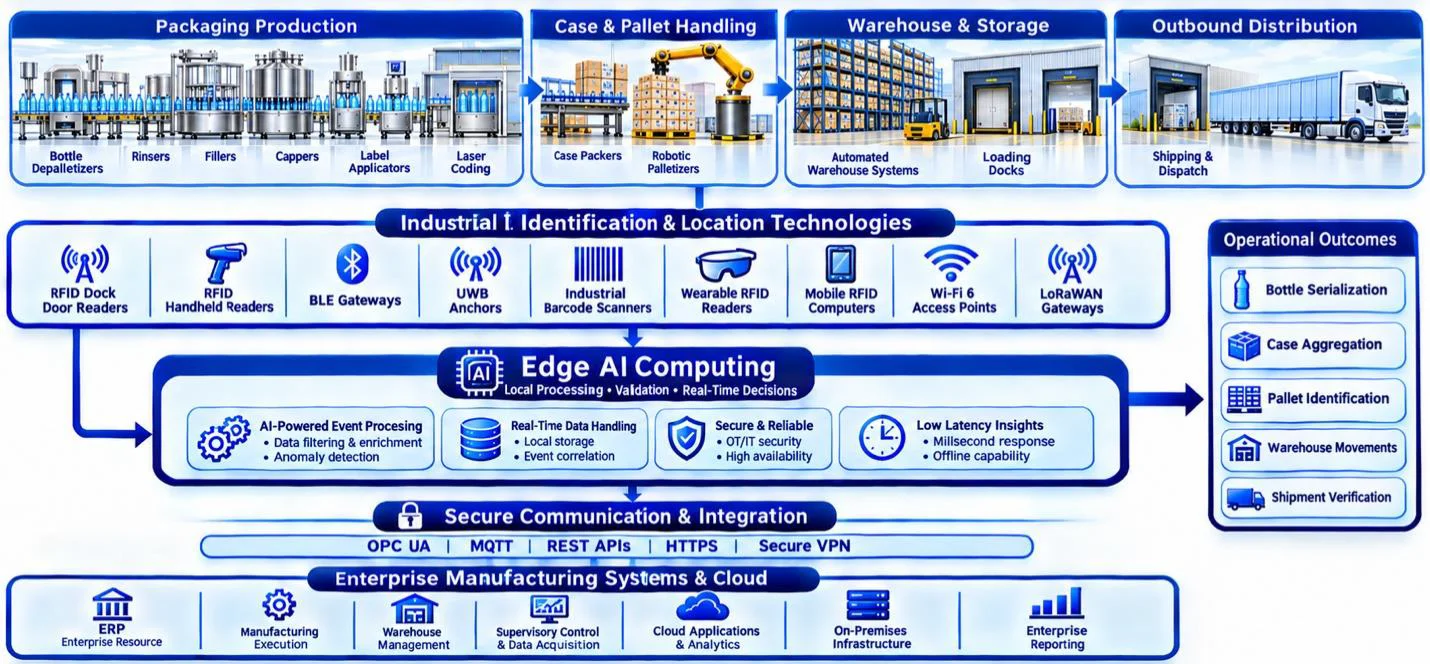
This block diagram illustrates how Edge AI processes industrial identification events locally across beverage packaging, warehouse, and distribution operations before securely synchronizing validated data with enterprise manufacturing systems. It shows RFID, BLE, UWB, barcode, Wi-Fi 6, LoRaWAN, and mobile identification technologies connected to Edge AI computing, where operational events are filtered, validated, and analyzed in real time. The processed information is securely integrated with ERP, MES, WMS, SCADA, cloud applications, and on-premises infrastructure through OPC UA, MQTT, and REST APIs, enabling bottle serialization, case aggregation, pallet identification, warehouse movement tracking, shipment verification, and real-time operational intelligence.
RFID Packaging Data Integration
RFID technology enables automated identification throughout production, warehousing, and distribution without requiring manual barcode scanning at every operational step.
Typical RFID-enabled assets include:
- Beverage pallets
- Returnable crates
- Plastic pallets
- Stainless steel containers
- Packaging tools
- Warehouse equipment
- Shipping containers
- Finished goods
- Packaging materials
Fixed RFID readers installed at production exits, warehouse portals, dock doors, and shipping lanes automatically capture identification events that synchronize with ERP, MES, and WMS software.
BLE Packaging Location Services
BLE location technologies provide real-time awareness of personnel, mobile assets, forklifts, handheld readers, and selected packaging equipment throughout manufacturing facilities.
Common applications include:
- Workforce location
- Shift personnel visibility
- Forklift coordination
- Packaging tool location
- Mobile computer positioning
- Restricted area verification
- Emergency mustering
- Warehouse personnel coordination
BLE complements RFID by adding location context to identification events without interrupting production workflows.
OPC UA Manufacturing Integration
OPC UA provides secure, standardized communication between packaging equipment and enterprise software. It enables consistent data exchange while maintaining interoperability across equipment from different manufacturers.
Typical information exchanged includes:
- Filling line status
- Machine availability
- Production counters
- Packaging throughput
- Batch execution
- Operational events
- Equipment alarms
- Diagnostic information
- Changeover status
Standardized communication simplifies long-term system maintenance and future expansion.
MQTT Industrial Messaging
MQTT enables lightweight, event-driven communication between distributed manufacturing systems, edge computing servers, and enterprise software.
Packaging facilities commonly use MQTT for:
- RFID event distribution
- Warehouse transaction messaging
- Mobile device communication
- Packaging notifications
- Edge synchronization
- Multi-site information exchange
- Production event publishing
- Distribution updates
Efficient MQTT messaging reduces communication overhead while supporting responsive, scalable AI and IoT integration across production facilities, warehouses, and beverage distribution networks.
Packaging Edge Computing
Packaging and bottling facilities generate an exceptionally high volume of identification events throughout every production shift. High-speed bottle fillers, canning lines, depalletizers, labeling systems, robotic palletizers, automated warehouses, and shipping operations continuously create RFID reads, barcode scans, BLE location updates, UWB positioning events, and production transactions. Processing every event in a centralized data center can increase network traffic and introduce unnecessary latency.
Edge computing addresses this challenge by processing identification and location events close to production operations before transmitting validated information to enterprise software. Within AI and IoT deployments, Edge AI software performs localized data validation, event correlation, workflow execution, and operational decision support while maintaining synchronization with ERP, MES, WMS, and SCADA systems.
This distributed processing approach improves operational responsiveness while reducing unnecessary network utilization and supporting uninterrupted packaging operations.
Typical edge computing functions include:
- RFID event filtering
- Industrial barcode validation
- BLE location processing
- UWB positioning calculations
- Duplicate read elimination
- Bottle serialization validation
- SSCC pallet verification
- Packaging workflow execution
- Lot genealogy association
- Returnable crate validation
- Local transaction buffering
- Communication retry management
- Packaging event prioritization
- Warehouse workflow processing
- Temporary offline operation
Instead of forwarding every raw identification event, Edge AI software consolidates and validates operational information before securely exchanging relevant transactions with enterprise manufacturing applications. This improves data quality while reducing the volume of unnecessary communication between production facilities and enterprise systems.
Edge AI Processing for Packaging Operations
Edge AI enables localized analysis of production events immediately after they occur. Rather than waiting for centralized processing, packaging facilities can evaluate operational workflows in near real time while maintaining synchronization with enterprise software.
Typical Edge AI applications include:
- Packaging workflow validation
- Bottle serialization verification
- Packaging material association
- Lot genealogy confirmation
- Production sequence validation
- Returnable crate movement verification
- Packaging line throughput analysis
- Bottleneck identification
- Pallet routing validation
- Warehouse movement coordination
- Workforce location verification
- Packaging asset utilization analysis
Processing information close to production equipment improves operational responsiveness while supporting continuous manufacturing.
Data Synchronization Across Enterprise Systems
Reliable synchronization is essential when multiple manufacturing facilities, warehouses, and distribution centers exchange production information. Edge computing maintains consistent operational records by securely synchronizing validated transactions with centralized enterprise software.
Synchronization methods commonly include:
- Transaction queuing
- Secure database replication
- Incremental synchronization
- Timestamp validation
- Event acknowledgment
- Conflict resolution
- Version control
- Scheduled synchronization
- Automatic retry mechanisms
- Data integrity verification
These capabilities help ensure that production records remain complete and consistent even when temporary communication interruptions occur.
Event Processing Throughout Packaging Operations
Every production activity generates operational events that must be interpreted before being shared with enterprise manufacturing software.
Examples include:
- Bottle identification
- Container aggregation
- Label application confirmation
- Bottle serialization
- Case completion
- Case aggregation
- SSCC pallet creation
- Warehouse receipt
- Storage location assignment
- Cross-docking transactions
- Shipment loading
- Distribution confirmation
- Returnable asset recovery
- Packaging material issuance
- Production order completion
PackBottle AI evaluates these events using configurable business rules to ensure that only validated operational information is exchanged with enterprise applications.
Offline Production Continuity
Continuous production is fundamental to beverage manufacturing. Temporary communication disruptions should not interrupt bottle filling, packaging, warehouse operations, or shipping activities.
Edge computing supports production continuity through:
- Local transaction storage
- Cached production orders
- Local authentication
- Buffered RFID transactions
- Local warehouse execution
- Offline pallet processing
- Automatic synchronization after reconnection
- Production continuity verification
These capabilities help maintain uninterrupted manufacturing while protecting the integrity of production records.
Enterprise Data Security
Food and beverage packaging operations process operational information that supports product quality, food safety, regulatory compliance, warehouse accountability, and business continuity. AI and IoT integration therefore requires a comprehensive cybersecurity strategy that protects information throughout its lifecycle, from collection and transmission to processing, storage, and long-term retention.
Enterprise security should encompass identification devices, industrial communication networks, application software, user authentication, data storage, and integration interfaces. A layered security model helps reduce operational risk while supporting corporate governance and regulatory requirements.
Important security controls include:
- Role-based access control (RBAC)
- Multi-factor authentication (MFA)
- End-to-end encrypted communications
- Digital certificate management
- Secure API authentication
- Device identity verification
- Network segmentation
- Security event logging
- Audit trail preservation
- Configuration management
- Backup and disaster recovery
- Vulnerability assessment
- Security patch management
Implementing these controls helps ensure that production information remains protected while maintaining reliable communication between manufacturing systems.
Secure Industrial Communications
Industrial communication standards play a central role in maintaining secure connectivity throughout packaging operations.
OPC UA supports:
- Mutual authentication
- Certificate-based trust
- Encrypted communications
- Secure session management
- User authentication
- Message integrity verification
MQTT implementations can also support secure communication through:
- TLS encryption
- Client authentication
- Access control lists
- Secure broker connections
- Message authorization
Together, these technologies provide secure communication between packaging equipment, Edge AI software, and enterprise manufacturing systems.
Identity and Access Management
Different operational roles require different levels of system access. Production operators, warehouse personnel, maintenance technicians, quality engineers, supervisors, system administrators, and external service providers should only access functions necessary for their responsibilities.
Identity management supports:
- Least-privilege access
- Centralized authentication
- Session timeout management
- Password policy enforcement
- User lifecycle management
- Temporary contractor accounts
- Administrative approval workflows
- Comprehensive access auditing
These practices strengthen operational security while improving accountability across manufacturing operations.
Regulatory Compliance and Food Safety
Packaging and bottling facilities operate under strict food safety, quality assurance, and product traceability requirements. AI and IoT integration supports these objectives by maintaining secure electronic production records throughout manufacturing and distribution.
Typical compliance records include:
- Electronic batch records
- Packaging material genealogy
- Bottle serialization history
- GS1 identifiers
- SSCC pallet records
- Warehouse movement history
- Distribution documentation
- Returnable asset history
- Product recall documentation
- Complete audit trails
Accurate electronic documentation simplifies compliance activities while improving product accountability throughout the supply chain.
AI and IoT Integration Best Practices
Successful AI and IoT integration projects require careful planning, standardized engineering methods, validated implementation procedures, and close collaboration between production, quality assurance, warehouse operations, maintenance, engineering, cybersecurity, and enterprise IT teams.
Organizations planning packaging integration projects should adopt structured implementation practices that promote long-term operational reliability.
Recommended engineering best practices include:
- Define measurable business and operational objectives before implementation.
- Establish standardized RFID, BLE, UWB, and barcode identification strategies across all production facilities.
- Develop consistent naming conventions for production lines, packaging equipment, warehouses, pallets, returnable transport items, and storage locations.
- Use open communication standards such as OPC UA, MQTT, and REST APIs wherever practical.
- Validate all ERP, MES, WMS, and SCADA interfaces before production deployment.
- Create comprehensive Factory Acceptance Testing (FAT) and Site Acceptance Testing (SAT) procedures.
- Maintain accurate master data for products, packaging materials, recipes, production resources, and warehouse locations.
- Document interface specifications, communication flows, and data mapping.
- Implement role-based cybersecurity policies with periodic access reviews.
- Continuously monitor communication performance, interface health, and transaction integrity.
- Establish structured software update, backup, and disaster recovery procedures.
- Train production, warehouse, quality, maintenance, and IT personnel on integrated operational workflows.
- Conduct periodic performance assessments to identify opportunities for optimization and future expansion.
Organizations that adopt standardized integration methodologies typically achieve faster deployments, improved operational visibility, reduced maintenance effort, more reliable production records, and stronger long-term return on investment.
PackBottle AI applies these engineering principles throughout every implementation. Created within Aperture Venture Studio with support from GAO, PackBottle AI builds upon more than two decades of industrial IoT experience gained through thousands of successful deployments across food and beverage manufacturing and other industrial sectors. Significant investment in research and development, rigorous quality assurance processes, remote and on-site technical support, and leadership from Ph.D. professionals help ensure that every deployment aligns with enterprise operational requirements. Our experience supporting Fortune 500 manufacturers, leading research institutions, prestigious universities, and U.S. and Canadian government agencies provides practical expertise for designing secure, scalable, and technically robust AI and IoT integration solutions for modern packaging and bottling operations.
Why Choose PackBottle AI for Packaging & Bottling Operations
Selecting an AI and IoT integration partner for food and beverage packaging and bottling operations requires more than evaluating software features. Successful deployments depend on industry knowledge, proven integration methodologies, industrial communication expertise, identification technologies, cybersecurity practices, and an understanding of high-speed manufacturing environments.
PackBottle AI is purpose-built for packaging and bottling operations where production continuity, product traceability, warehouse accuracy, and regulatory compliance are essential. Our AI and IoT software integrates with existing enterprise manufacturing systems rather than requiring organizations to replace established ERP, MES, WMS, SCADA, or warehouse software investments.
Our engineering approach emphasizes practical deployment, open integration standards, operational reliability, and long-term maintainability. By combining AI and IoT software with RFID, BLE, UWB, industrial barcode technologies, OPC UA, MQTT, REST APIs, Edge AI, cloud software, and on-premises deployments, manufacturers can modernize packaging operations while minimizing disruption to production.
PackBottle AI helps organizations:
- Integrate packaging operations with enterprise manufacturing systems.
- Improve bottle, case, pallet, and returnable transport item traceability.
- Automate identification event processing using RFID and industrial barcode technologies.
- Improve packaging material accountability throughout production.
- Strengthen warehouse inventory accuracy using automated identification.
- Improve bottle serialization and GS1 compliance.
- Maintain complete lot genealogy and electronic batch records.
- Support FEFO inventory strategies within beverage warehouses.
- Improve warehouse receiving, storage, staging, and shipping accuracy.
- Enhance returnable crate utilization and recovery.
- Improve production reporting while reducing manual data entry.
- Support secure communication between manufacturing systems.
- Enable scalable multi-plant deployments across enterprise operations.
Rather than delivering generic industrial software, PackBottle AI focuses specifically on the operational workflows, regulatory expectations, and production realities of food and beverage packaging and bottling facilities.
Benefits of Enterprise AI and IoT Integration
Organizations implementing AI and IoT integration within packaging and bottling operations often realize measurable operational improvements across manufacturing, warehousing, quality assurance, and supply chain management.
Operational benefits include:
- Improved bottle and case traceability.
- Faster identification of packaging materials and finished goods.
- Reduced manual inventory transactions.
- Improved production scheduling accuracy.
- Better utilization of returnable transport items.
- Improved warehouse productivity.
- Reduced shipping discrepancies.
- More accurate electronic batch records.
- Stronger regulatory compliance.
- Improved GS1 serialization support.
- Better lot genealogy management.
- Reduced packaging material waste.
- Greater production visibility across multiple filling lines.
- More efficient warehouse replenishment.
- Improved production and warehouse coordination.
- Enhanced operational decision-making using validated production data.
- Better support for enterprise reporting and business analytics.
- Simplified product recall preparation through comprehensive traceability records.
Because AI and IoT software continuously exchanges verified operational information with enterprise systems, manufacturers gain a more complete understanding of production performance without increasing manual administrative effort.
Built on Decades of Industrial Innovation
PackBottle AI was created within Aperture Venture Studio with support from GAO to address the growing demand for enterprise AI and IoT solutions across industrial manufacturing sectors. Building upon more than two decades of industrial IoT experience, our team has contributed to thousands of successful IoT projects serving food and beverage manufacturers and other industrial organizations worldwide.
Extensive investments in research and development, rigorous quality assurance processes, and technical leadership from Ph.D. professionals enable PackBottle AI to deliver practical, enterprise-grade solutions for complex manufacturing environments. Our experience includes supporting Fortune 500 companies, leading research organizations, prestigious universities, and government agencies throughout the United States and Canada.
This foundation allows us to combine proven industrial engineering practices with modern AI and IoT technologies to develop secure, scalable, and interoperable solutions that integrate with existing manufacturing software while supporting future operational growth.
Contact PackBottle AI
Modern food and beverage packaging operations require accurate identification, reliable enterprise connectivity, secure communication, and complete production traceability. Whether your organization is expanding RFID infrastructure, integrating ERP and MES software, improving warehouse visibility, implementing GS1 serialization, enhancing returnable transport item management, or deploying Edge AI across multiple manufacturing facilities, PackBottle AI can help you develop an integration strategy aligned with your operational objectives.
Our objective is to help food and beverage manufacturers build reliable AI and IoT environments that improve production efficiency, warehouse operations, inventory visibility, packaging traceability, and enterprise decision-making while preserving existing manufacturing investments.
Modernize Packaging & Bottling Operations with Enterprise AI and IoT Integration
Improve workforce visibility, packaging asset identification, warehouse inventory accuracy, bottle serialization, pallet traceability, GS1 compliance, EPCIS event capture, returnable transport item management, and beverage distribution using industrial RFID, BLE, UWB, barcode, LoRaWAN, Wi-Fi, Cellular, GPS, and NFC technologies. Contact PackBottle AI to discuss an AIoT integration solution engineered specifically for packaging and bottling operations within the Food & Beverage Manufacturing Industry.