
Discover enterprise AI and IoT applications for Packaging & Bottling Operations within the Food & Beverage Manufacturing Industry.
Improve beverage filling, bottle packaging, aluminum canning, labeling, palletizing, packaging inventory, bottle serialization, lot genealogy, cold chain traceability, and warehouse logistics using RFID, BLE, UWB, industrial barcode, Wi-Fi, LoRaWAN, GPS, MQTT, OPC UA, and Edge AI.
AI and IoT Applications for Packaging & Bottling Operations Across Modern Food & Beverage Manufacturing
Packaging & Bottling Operations represent one of the most automation-intensive environments within the Food & Beverage Manufacturing Industry. High-speed beverage filling lines, bottle handling systems, aluminum canning lines, labeling machines, cartoners, robotic palletizers, warehouse logistics, and distribution operations must operate as a synchronized production system where every bottle, can, carton, pallet, reusable crate, and production asset is accurately identified and tracked.
AI and IoT combines AI with connected identification and location technologies to transform operational visibility throughout packaging facilities. Rather than relying on manual barcode scans or paper-based production records, AIoT continuously identifies products, packaging materials, mobile assets, production equipment, and authorized personnel while analyzing operational events to improve productivity, traceability, quality assurance, and supply chain execution.
Packaging & Bottling Operations increasingly depend on RFID, Bluetooth® Low Energy (BLE), Ultra-Wideband (UWB), industrial barcode systems, Wi-Fi, LoRaWAN, GPS, cellular communications, Edge AI, OPC UA, and MQTT to automate product identification, warehouse movement, bottle serialization, pallet verification, returnable packaging management, and enterprise reporting.
Packaging & Bottling Applications Overview
Packaging & Bottling Operations encompass every production activity between primary filling and outbound distribution. Products move through bottle rinsing, filling, capping, crowning, seaming, leak inspection, label application, date coding, laser marking, vision inspection, checkweighing, case packing, cartoning, robotic palletizing, stretch wrapping, warehouse staging, refrigerated storage, and outbound shipping.
Every production stage depends on accurate identification of:
- Production personnel
- Contractors
- Packaging equipment
- Filling machines
- Mobile maintenance tools
- Returnable transport items (RTIs)
- Empty bottles
- Glass bottles
- PET bottles
- Aluminum cans
- Closures and caps
- Label rolls
- Corrugated cartons
- Shrink film
- Finished cases
- Finished pallets
- Warehouse locations
- Distribution vehicles
Production interruptions frequently occur because packaging materials cannot be located quickly, reusable pallets are unavailable, production batches cannot be reconciled efficiently, forklifts spend excessive time locating inventory, or incorrect packaging components reach production lines.
AI and IoT addresses these operational challenges by continuously identifying and locating people, assets, inventory, work-in-progress, finished goods, and returnable packaging assets throughout the facility.
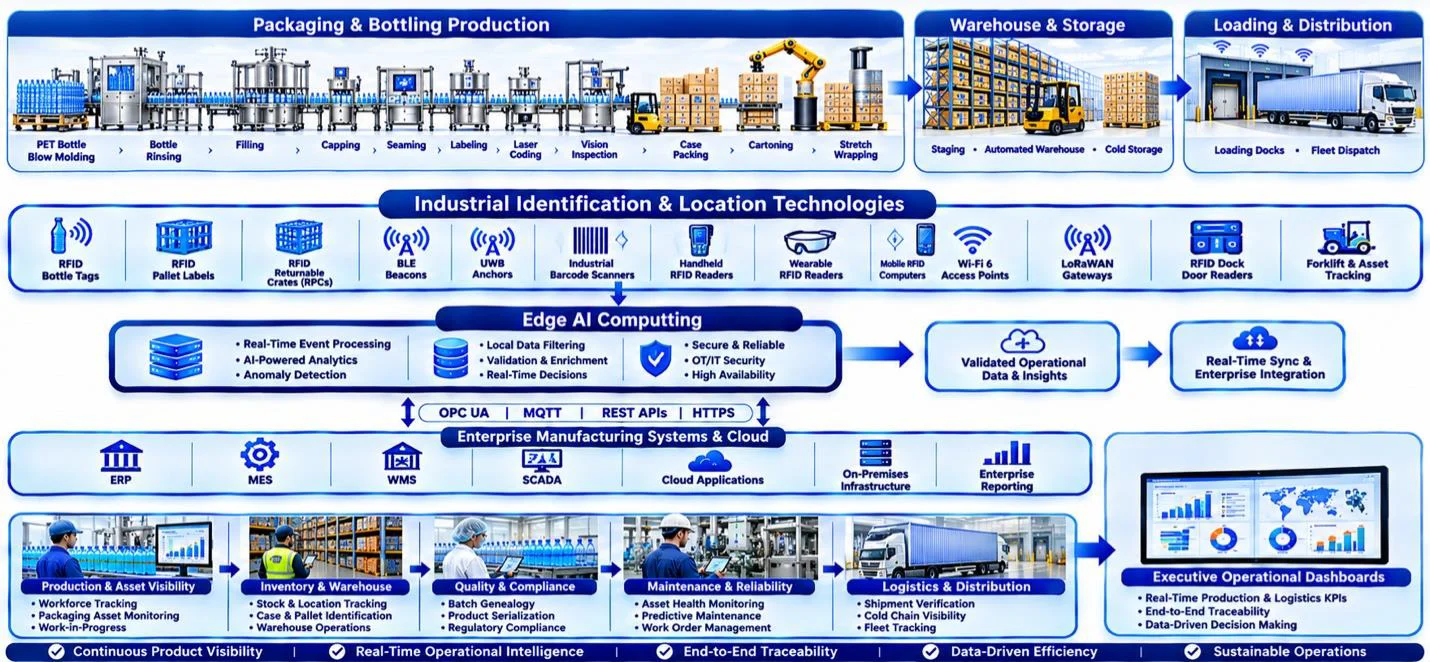
End-to-End AI + IoT Identification and Location Workflow for Beverage Packaging & Bottling
This workflow diagram illustrates how AI-powered identification and location technologies provide continuous visibility across a beverage packaging and bottling operation, from PET bottle production through packaging, warehousing, and outbound distribution. It shows RFID, BLE, UWB, barcode scanning, Wi-Fi, LoRaWAN, and Edge AI processing integrated with ERP, MES, WMS, SCADA, cloud applications, and enterprise dashboards to support real-time asset tracking, workforce visibility, product serialization, inventory management, logistics coordination, and end-to-end operational intelligence.
Beverage Filling Operations
Beverage filling operations are among the highest-throughput manufacturing environments in the Food & Beverage Manufacturing Industry. Modern rotary fillers, gravity fillers, volumetric fillers, aseptic fillers, and pressure filling systems may process tens of thousands of bottles or cans every hour while maintaining stringent hygiene, quality, and traceability requirements.
Maintaining continuous production requires synchronized movement of bottles, caps, closures, labels, cartons, pallets, maintenance personnel, sanitation crews, forklifts, and packaging materials. A delay affecting any one of these resources can reduce Overall Equipment Effectiveness (OEE), increase changeover time, and impact production schedules.
AI and IoT improves filling operations by providing automated identification and location awareness throughout the production process. RFID, industrial barcode systems, BLE identification, UWB positioning, and Edge AI software create a digital record of operational events without depending exclusively on manual scanning.
Common beverage filling applications include:
- Bottled water production
- Carbonated soft drink bottling
- Dairy beverage filling
- Juice bottling
- Functional beverage packaging
- Sports drink production
- Brewery bottling
- Winery bottling
- Ready-to-drink coffee packaging
- Ready-to-drink tea production
- Liquid food packaging
- Contract beverage manufacturing
Production supervisors gain continuous visibility into packaging line activities, enabling faster responses to material shortages, equipment availability issues, production bottlenecks, and warehouse replenishment requirements.
Packaging Workforce Location and Shift Coordination
Efficient packaging operations depend upon coordinated movement of operators, mechanics, sanitation personnel, electricians, quality inspectors, warehouse personnel, and production supervisors.
AI and IoT workforce location solutions improve operational coordination by automatically identifying authorized personnel throughout production areas while supporting workforce accountability during routine production, preventive maintenance, sanitation activities, shift transitions, and emergency response.
Typical workforce applications include:
- Packaging line personnel location
- Filling operator movement analysis
- Packaging shift attendance
- Maintenance technician dispatch
- Sanitation crew coordination
- Emergency mustering
- Contractor access verification
- Lone worker monitoring for isolated maintenance activities
- Production workforce allocation
- Warehouse workforce coordination
Authorized location awareness helps reduce production delays by improving personnel coordination during equipment maintenance, line changeovers, sanitation cycles, and packaging material replenishment.
Hygienic Filling Zone Access Compliance
Packaging & Bottling Operations frequently contain hygienically controlled production environments where personnel access must follow established food safety procedures.
Examples include:
- Aseptic filling rooms
- High-care production zones
- Bottle sterilization areas
- Ingredient preparation rooms
- Clean packaging cells
- Finished beverage storage areas
- Clean-In-Place (CIP) maintenance zones
- Packaging quality laboratories
AI and IoT access verification automatically records authorized entry events while helping manufacturers demonstrate compliance with food safety procedures, internal operating policies, and customer audit requirements.
Automated access records simplify compliance documentation while reducing administrative effort associated with manual visitor logs and paper-based access records.
Bottle Packaging Lines
Bottle packaging lines integrate multiple automated production systems into a continuous manufacturing process. Conveyors, accumulation tables, label applicators, laser coders, vision inspection systems, checkweighers, case packers, robotic palletizers, stretch wrappers, and warehouse logistics must remain synchronized to achieve maximum production throughput.
AI and IoT improves bottle packaging operations by providing continuous identification of bottles, cartons, pallets, packaging materials, mobile assets, warehouse inventory, and production equipment throughout every packaging stage.
Typical bottle packaging activities include:
- PET bottle packaging
- Glass bottle packaging
- HDPE bottle packaging
- Shrink sleeve packaging
- Pressure-sensitive labeling
- Multipack assembly
- Tray packing
- Wrap-around cartoning
- Case packing
- Stretch wrapping
- Pallet staging
- Warehouse transfer
Automated identification reduces manual verification activities while improving packaging accuracy, inventory reconciliation, and warehouse coordination.
Packaging Asset Identification and Utilization
Packaging facilities operate thousands of reusable operational assets that support daily production.
Examples include:
- Returnable plastic crates (RPCs)
- Beverage pallets
- Roll cages
- Forklifts
- Electric pallet jacks
- Mobile packaging carts
- Tool cabinets
- Portable label printers
- Handheld RFID readers
- Industrial barcode scanners
- Mobile computers
- Quality inspection equipment
AI and IoT solutions automatically identify and locate these assets using RFID labels, BLE tags, UWB positioning, and industrial barcode technologies.
Operational benefits include:
- Reduced equipment search time
- Improved asset utilization
- Better preventive maintenance planning
- Reduced replacement costs
- Faster packaging line changeovers
- Improved warehouse coordination
- Increased operational accountability
- Better asset lifecycle management
Organizations operating multiple beverage plants can standardize identification methods across facilities, improving reporting consistency and simplifying enterprise asset management.
Packaging Material Inventory Management
Continuous beverage production depends on uninterrupted availability of packaging materials. Empty bottles, aluminum cans, caps, closures, label rolls, corrugated cartons, shrink film, trays, adhesives, pallets, and returnable transport items must arrive at the appropriate production line at precisely the right time.
AI and IoT software improves inventory visibility by automatically identifying material movements throughout receiving, warehouse storage, production staging, line-side replenishment, production consumption, and finished goods warehousing.
Typical inventory categories include:
- Empty bottle inventory
- Aluminum can inventory
- Cap and closure inventory
- Label roll inventory
- Corrugated carton inventory
- Shrink film inventory
- Finished package inventory
- Returnable packaging inventory
- Warehouse pallet inventory
- Packaging spare parts inventory
Automated identification supports faster inventory reconciliation, improves warehouse replenishment planning, reduces production interruptions, and enhances packaging material traceability across the entire manufacturing process.
PackBottle AI was established within Aperture Venture Studio with support from GAO, leveraging more than two decades of industrial IoT implementation experience. The organization's expertise is built upon thousands of successful deployments across manufacturing environments, supported by extensive research and development, rigorous quality assurance practices, and experienced engineering teams that understand the operational demands of high-speed Packaging & Bottling Operations.
Aluminum Can Packaging
Aluminum can packaging operations represent some of the fastest continuous production environments in the Food & Beverage Manufacturing Industry. Modern canning lines routinely process hundreds to well over one thousand cans per minute, requiring precise coordination between depalletizers, rinsers, fillers, seamers, leak inspection systems, date coders, vision inspection stations, checkweighers, multipack equipment, case packers, robotic palletizers, warehouse staging areas, and shipping operations.
Because every production stage depends on synchronized material flow, even a brief interruption can reduce Overall Equipment Effectiveness (OEE), create downstream congestion, increase product rework, or generate unnecessary production downtime.
AI and IoT enhances aluminum can packaging by automatically identifying production assets, packaging materials, work-in-progress, finished pallets, mobile equipment, and authorized personnel throughout the packaging process. Continuous identification allows production supervisors to monitor operational flow, evaluate bottlenecks, improve production scheduling, and maintain complete production genealogy.
Typical aluminum can packaging applications include:
- Carbonated soft drink canning
- Beer packaging
- Energy drink production
- Sparkling water packaging
- Ready-to-drink coffee canning
- Ready-to-drink tea packaging
- Functional beverage production
- Juice canning
- Nutritional beverage packaging
- Contract beverage manufacturing
Rather than relying on periodic manual inventory updates, AI and IoT continuously records operational events, creating an accurate digital production history for every manufacturing batch.
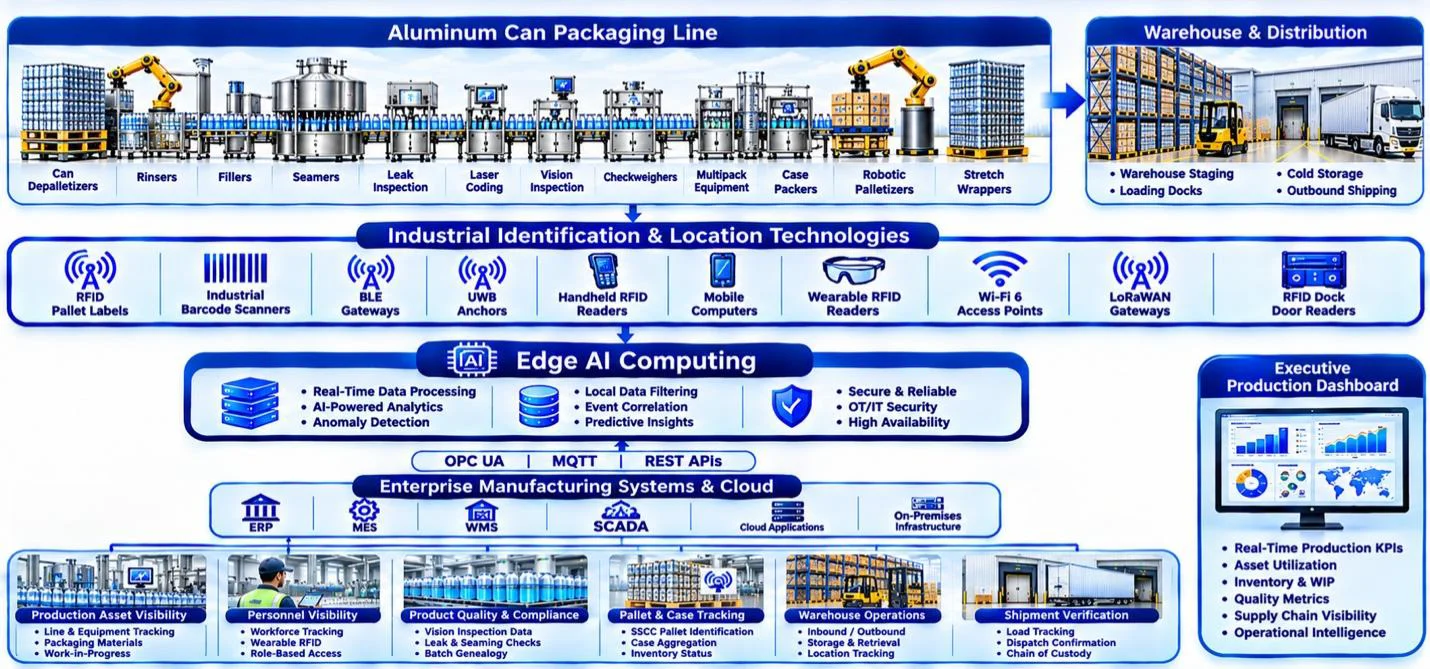
AI + IoT Identification Architecture for High-Speed Aluminum Can Packaging
This block diagram illustrates how AI and IoT identification technologies provide continuous visibility across a high-speed aluminum can packaging operation, from can depalletizing through warehousing and outbound shipping. It shows RFID, barcode scanning, BLE, UWB, Wi-Fi 6, LoRaWAN, handheld readers, mobile computers, and Edge AI processing integrated with ERP, MES, WMS, SCADA, and cloud platforms using OPC UA and MQTT. The architecture enables real-time tracking of production assets, personnel, packaging materials, work-in-progress, pallet identification, shipment verification, and executive production analytics for end-to-end operational visibility.
Packaging Line Throughput Optimization
Packaging throughput depends on balanced movement between upstream and downstream equipment.
Identification technologies improve production coordination by providing visibility into:
- Depalletizer output
- Filling line utilization
- Seaming operations
- Packaging queue lengths
- Conveyor accumulation
- Production changeovers
- Material replenishment timing
- Warehouse pallet availability
- Finished goods transfer
- Packaging equipment utilization
Production engineers can analyze these identification events to improve line balancing, reduce idle equipment, optimize labor allocation, and minimize production interruptions.
Edge AI software can further assist by recognizing recurring operational patterns that contribute to bottlenecks, allowing production managers to implement corrective actions before throughput is significantly affected.
Packaging Work-in-Progress Identification
Work-in-progress (WIP) includes partially completed products moving between filling, seaming, labeling, coding, inspection, case packing, palletizing, warehouse staging, and finished goods storage.
Maintaining accurate WIP visibility becomes increasingly important during:
- Product changeovers
- Shift transitions
- Quality investigations
- Production balancing
- Warehouse replenishment
- Maintenance shutdowns
- Production scheduling
- Customer order prioritization
AI and IoT automatically identifies WIP using RFID labels, industrial barcode systems, BLE identification devices, UWB location technologies, and warehouse identification software.
Operational advantages include:
- Continuous batch visibility
- Improved production reconciliation
- Reduced manual reporting
- Better packaging sequence management
- Faster production reporting
- Improved inventory synchronization
- Faster root cause investigations
- Improved production planning
Automated identification provides a continuously updated operational view instead of relying on periodic manual production reports.
Cartoning Operations
Cartoning operations consolidate individual bottles or cans into retail-ready, wholesale, or distribution-ready packaging while preserving production accuracy and product traceability. High-speed automated cartoners, case erectors, case sealers, and pallet preparation systems require precise coordination with upstream packaging equipment to prevent production disruptions.
AI and IoT improves cartoning efficiency by automatically identifying cartons, packaging materials, finished cases, production lots, warehouse destinations, and outbound customer orders throughout the packaging process.
Typical cartoning applications include:
- Wrap-around cartoning
- Regular slotted container packaging
- Tray-and-film packaging
- Retail-ready packaging
- Shelf-ready packaging
- Promotional packaging
- Mixed SKU packaging
- Display packaging
- Case sealing
- Distribution case preparation
Automatic identification reduces shipping errors while improving warehouse receiving, inventory accuracy, and customer order fulfillment.
Case Identification and Packaging Genealogy
Every finished case should maintain a verifiable relationship with the individual bottles or cans contained within it.
AI and IoT supports comprehensive packaging genealogy through:
- Case serialization
- Production batch association
- Packaging lot identification
- Shift association
- Production line association
- Warehouse location assignment
- Customer shipment verification
- Recall documentation support
Maintaining digital genealogy significantly reduces the time required to isolate affected production lots during quality investigations or regulatory audits.
Enterprise manufacturers also benefit from improved reporting consistency across multiple production facilities by standardizing serialization and case identification procedures.
Finished Case Warehouse Visibility
Warehouse efficiency depends upon accurate identification of every finished case from production through customer shipment.
Identification technologies improve warehouse operations by supporting:
- Automated warehouse receiving
- Storage location assignment
- Order picking verification
- Cross-docking
- Customer order consolidation
- Trailer loading verification
- Distribution center transfers
- Warehouse inventory reconciliation
RFID labels, industrial barcode systems, handheld RFID readers, BLE identification devices, and warehouse management software work together to improve operational visibility while reducing manual warehouse transactions.
Bottle Labeling Operations
Bottle labeling combines regulatory compliance, consumer information, production identification, branding, and product traceability within a single production stage. Every label must correspond to the correct product, packaging configuration, production batch, language requirements, nutrition information, expiration date, and distribution destination.
Packaging facilities frequently process multiple bottle sizes, product formulations, seasonal promotions, and customer-specific packaging configurations on the same production line.
AI and IoT improves labeling operations by automatically identifying bottles, label rolls, production batches, packaging materials, and finished products throughout the labeling process.
Typical labeling applications include:
- Pressure-sensitive labeling
- Shrink sleeve labeling
- Roll-fed labeling
- Wrap-around labeling
- Front-and-back labeling
- Tamper-evident labeling
- Promotional labeling
- Nutrition labeling
- Laser coding
- Inkjet date coding
Automatic identification improves production accuracy while helping prevent incorrect label application and packaging mix-ups.
Label Roll Inventory Identification
Large beverage manufacturing facilities often manage thousands of label roll variations supporting different brands, package sizes, languages, regulatory requirements, promotional campaigns, and regional distribution markets.
AI and IoT provides continuous visibility into:
- Label roll inventory
- Warehouse storage locations
- Production line replenishment
- Production consumption
- Remaining inventory
- Batch allocation
- Inventory rotation
- Warehouse transfers
Improved inventory visibility reduces production downtime caused by unavailable or misplaced labeling materials while simplifying warehouse inventory management.
Bottle Serialization and Product Traceability
Bottle serialization establishes a unique digital identity for individual products or production units, creating complete traceability throughout manufacturing and distribution.
AI and IoT supports:
- Bottle serialization
- Product authentication
- Packaging genealogy
- Production lot verification
- Case association
- Pallet association
- Distribution verification
- Customer shipment confirmation
- Regulatory documentation
- Recall readiness
Serialization strengthens quality assurance by enabling manufacturers to rapidly identify production history, shipment destinations, and related packaging records for affected products.
Robotic Palletizing Operations
Robotic palletizing systems automate one of the most physically demanding stages of Packaging & Bottling Operations by stacking finished cartons, trays, shrink-wrapped multipacks, and cases onto pallets according to predefined pallet patterns and customer shipping requirements.
AI and IoT improves robotic palletizing by continuously identifying finished products, pallets, forklifts, warehouse staging locations, and outbound shipping units. Accurate identification ensures that each completed pallet is correctly associated with its production batch, warehouse location, and customer shipment before leaving the production area.
Common robotic palletizing applications include:
- Beverage case palletizing
- Mixed SKU pallet building
- Layer pattern verification
- Pallet label verification
- Stretch wrapping preparation
- Warehouse staging
- Dock assignment
- Shipping verification
- Export pallet preparation
- Distribution center transfers
Automated identification also supports faster warehouse receiving, improved pallet utilization, and more accurate inventory reconciliation.
Finished Pallet Identification and Warehouse Staging
Finished pallets serve as the primary inventory unit for warehousing, distribution, and customer delivery.
AI and IoT automatically records pallet movements during:
- End-of-line production
- Warehouse transfer
- Cold storage placement
- Cross-docking
- Shipping preparation
- Trailer loading
- Distribution center receiving
- Customer delivery confirmation
- Return logistics
RFID pallet labels, industrial barcode systems, BLE identification devices, GPS fleet tracking, Wi-Fi communications, LoRaWAN warehouse infrastructure, and Edge AI software maintain accurate pallet identification records throughout the logistics process.
Organizations operating multiple beverage production facilities benefit from standardized pallet identification practices that improve enterprise inventory visibility, simplify warehouse operations, and support consistent reporting across regional manufacturing and distribution networks.
PackBottle AI's capabilities are supported by substantial investments in research and development, comprehensive quality assurance programs, and experienced engineering professionals who have implemented industrial IoT identification solutions for Fortune 500 manufacturers, leading research organizations, major universities, and government agencies. This practical deployment experience enables packaging and bottling organizations to implement AI and IoT solutions that integrate effectively with existing production environments while supporting long-term operational scalability.
Finished Goods Dispatch
Finished goods dispatch represents the final manufacturing stage before products enter warehouse logistics and commercial distribution. Every finished pallet, mixed SKU load, returnable transport item (RTI), export shipment, and customer order must be accurately identified before leaving the production facility to ensure shipping accuracy, regulatory compliance, customer satisfaction, and complete product traceability.
Packaging & Bottling Operations often manage thousands of finished pallets each day across multiple production lines, warehouse zones, refrigerated storage areas, and shipping docks. Manual shipment verification can introduce loading errors, inventory discrepancies, shipment delays, incorrect customer deliveries, and extended reconciliation activities.
AI and IoT enhances dispatch operations by automatically identifying finished pallets, warehouse storage locations, forklifts, loading docks, trailers, customer orders, and shipping documentation throughout outbound logistics.
Typical finished goods dispatch activities include:
- Finished pallet verification
- Warehouse release authorization
- Trailer loading confirmation
- Shipping lane assignment
- Customer order verification
- Mixed-load validation
- Export shipment preparation
- Distribution center transfers
- Cross-docking operations
- Shipping documentation reconciliation
- Reverse logistics preparation
- Returnable asset dispatch
Automated identification reduces manual paperwork while improving warehouse accuracy, shipment verification, inventory synchronization, and transportation efficiency.
Dock Door Identification and Shipping Verification
Loading docks serve as the primary transition point between manufacturing operations and transportation networks. Every shipment passing through these controlled locations should be digitally verified before departure.
AI and IoT improves dock operations by automatically recording:
- Pallet arrivals
- Dock assignments
- Trailer identification
- Vehicle loading sequence
- Shipping completion
- Forklift movement
- Outbound shipment verification
- Warehouse inventory updates
- Dispatch timestamps
- Customer shipment confirmation
RFID dock door portals, industrial barcode scanners, BLE gateways, handheld RFID readers, mobile computers, Wi-Fi communications, and Edge AI software generate reliable identification records without interrupting warehouse productivity.
Automated dock verification reduces loading errors, improves shipping accuracy, and simplifies warehouse auditing while supporting customer-specific shipping requirements.
Fleet and Distribution Logistics Coordination
Product visibility should continue beyond the manufacturing facility and extend throughout the distribution network.
AI and IoT identification technologies support:
- Trailer verification
- Vehicle assignment
- Route validation
- Distribution center receiving
- Shipment confirmation
- Delivery documentation
- Returnable asset recovery
- Warehouse transfer verification
- Fleet utilization reporting
- Transportation history
GPS fleet identification, RFID shipment verification, industrial barcode technologies, Wi-Fi communications, and cellular connectivity maintain continuity between manufacturing facilities, regional warehouses, wholesalers, retailers, and food service distribution centers.
This end-to-end identification capability supports greater logistics transparency while improving customer fulfillment performance.
Returnable Packaging Operations
Returnable packaging assets represent a substantial operational investment throughout Packaging & Bottling Operations. Beverage manufacturers rely on reusable pallets, returnable plastic crates (RPCs), roll cages, beverage kegs, transport totes, reusable trays, intermediate containers, and specialized distribution assets that continuously circulate between manufacturing plants, warehouses, distributors, retailers, and customers.
Without reliable identification, these assets may become misplaced, remain idle for extended periods, or require premature replacement, increasing operating costs and reducing logistics efficiency.
AI and IoT enables continuous identification and location awareness for returnable packaging assets using RFID labels, BLE identification devices, industrial barcode systems, UWB positioning, and warehouse location software.
Typical returnable packaging applications include:
- Returnable plastic crate tracking
- Beverage pallet identification
- Keg tracking
- Roll cage management
- Transport tote identification
- Reusable tray management
- Distribution asset recovery
- Warehouse return verification
- Customer asset reconciliation
- Cleaning cycle management
- Maintenance scheduling
- Asset retirement planning
Automated identification provides continuous operational visibility while reducing manual inventory reconciliation and improving reusable asset utilization.
Returnable Asset Lifecycle Management
Every reusable packaging asset progresses through multiple operational stages during its service life.
Typical lifecycle activities include:
- Asset procurement
- Digital identification assignment
- Warehouse storage
- Production deployment
- Distribution
- Customer utilization
- Asset return
- Inspection
- Washing and sanitation
- Preventive maintenance
- Redeployment
- Retirement
AI and IoT software records identification events throughout every lifecycle stage, enabling operations managers to evaluate utilization rates, maintenance history, asset availability, replacement planning, and long-term return on investment.
Historical identification records also support operational audits and continuous improvement initiatives.
Packaging Equipment Utilization
High-volume packaging facilities rely upon numerous mobile production assets that must remain readily available throughout every production shift.
Common equipment includes:
- Mobile packaging carts
- Portable label printers
- Tool cabinets
- Industrial tablets
- Handheld RFID readers
- Mobile barcode scanners
- Forklifts
- Electric pallet jacks
- Mobile operator terminals
- Quality inspection equipment
- Maintenance tool kits
- Production support carts
AI and IoT continuously identifies these operational assets, improving equipment availability while reducing time spent searching for critical production resources.
Maintenance teams can also evaluate historical utilization patterns to improve preventive maintenance scheduling and equipment allocation.
Cold Beverage Storage
Cold beverage storage supports products that require refrigerated warehousing before shipment to distributors, retailers, hospitality providers, institutional customers, and food service organizations.
Packaging & Bottling Operations must maintain accurate identification throughout refrigerated warehouses despite frequent inventory movement between production, staging, refrigerated storage, cross-docking, and outbound transportation.
AI and IoT supports refrigerated warehouse operations by continuously identifying pallets, warehouse locations, forklifts, loading docks, storage aisles, and outbound shipments while preserving complete production genealogy.
Typical cold storage applications include:
- Refrigerated finished goods storage
- Beverage pallet identification
- Warehouse location management
- Order picking verification
- Cold room inventory reconciliation
- Shipping preparation
- Cross-docking
- Seasonal inventory management
- Export shipment staging
- Distribution center replenishment
These identification capabilities improve warehouse productivity while reducing manual inventory searches and shipping delays.
Cold Chain Traceability
Cold chain logistics require comprehensive documentation demonstrating where products have been stored, transferred, and distributed throughout the supply chain.
AI and IoT supports cold chain traceability by recording identification events including:
- Warehouse receiving
- Storage location assignment
- Internal warehouse transfers
- Order picking
- Shipping preparation
- Trailer loading
- Distribution center receiving
- Delivery confirmation
- Return logistics
RFID pallet labels, industrial barcode systems, BLE identification, LoRaWAN warehouse communications, Wi-Fi connectivity, GPS fleet identification, and Edge AI software together create a complete digital identification history that supports regulatory compliance, product recalls, customer documentation, and enterprise reporting.
Because Packaging & Bottling Operations frequently distribute products across regional, national, and international supply chains, maintaining accurate identification records becomes essential for preserving product integrity and operational accountability.
Beverage Distribution Centers
Beverage distribution centers connect manufacturing plants with wholesalers, retailers, supermarkets, convenience stores, restaurants, institutional food service providers, vending operations, and regional warehouses.
Distribution efficiency depends upon accurate product identification, warehouse visibility, order fulfillment accuracy, and coordinated outbound logistics.
AI and IoT automates identification throughout receiving, storage, picking, pallet consolidation, shipping, and returnable packaging management.
Typical distribution center applications include:
- Receiving verification
- Warehouse inventory identification
- Pallet location management
- Order fulfillment verification
- Mixed pallet consolidation
- Cross-docking
- Trailer loading
- Customer shipment verification
- Empty pallet management
- Returnable crate processing
- Reverse logistics
- Warehouse inventory reconciliation
Continuous identification enables warehouse personnel to locate products more efficiently while reducing picking errors, shipping discrepancies, and manual inventory reconciliation activities.
Multi-Facility Warehouse and Distribution Visibility
Many food and beverage manufacturers operate multiple packaging plants, regional warehouses, and distribution centers.
Standardized AI and IoT identification methods provide consistent operational visibility across geographically distributed facilities by supporting:
- Enterprise inventory reconciliation
- Unified pallet identification
- Warehouse transfer documentation
- Cross-facility shipment verification
- Production genealogy
- Distribution reporting
- Returnable asset balancing
- Inventory optimization
- Operational performance benchmarking
- Executive reporting
Consistent identification standards simplify enterprise operations while supporting coordinated logistics across complex food and beverage supply chains.
Operational Benefits
Implementing AI and IoT identification and location solutions throughout Packaging & Bottling Operations delivers measurable operational improvements across manufacturing, warehousing, logistics, and distribution.
Organizations commonly achieve benefits such as:
- Improved packaging workforce coordination
- Enhanced hygienic area access compliance
- Faster packaging asset identification
- Better returnable packaging utilization
- Improved packaging material availability
- Higher inventory accuracy
- Greater work-in-progress visibility
- Improved bottle serialization
- More comprehensive packaging lot genealogy
- Faster warehouse receiving and shipping
- Improved robotic palletizing efficiency
- Better finished goods dispatch accuracy
- Enhanced cold chain traceability
- Reduced manual documentation
- Faster production reconciliation
- Improved regulatory compliance support
- Greater recall readiness
- Better enterprise reporting
- Improved operational transparency
- Increased production efficiency
When integrated with ERP, MES, WMS, SCADA, QMS, CMMS, OPC UA communications, MQTT messaging, and Edge AI software, these identification capabilities provide a unified operational view across production, warehouse logistics, distribution, and enterprise management, enabling packaging and bottling organizations to make faster, more informed operational decisions while maintaining complete product traceability and regulatory documentation.
Engineering Best Practices for AI and IoT Deployments in Packaging & Bottling Operations
Successful AI and IoT deployments in Packaging & Bottling Operations require much more than installing RFID readers or barcode scanners. Enterprise implementations should align identification technologies with production workflows, packaging line automation, warehouse logistics, food safety programs, quality management procedures, and enterprise software integrations.
Because beverage filling and packaging lines operate at high throughput with minimal production tolerance, every identification point should be engineered to maintain production flow without introducing operational bottlenecks.
Recommended engineering best practices include:
- Define measurable operational objectives before selecting identification technologies.
- Conduct detailed production line surveys covering filling, labeling, cartoning, palletizing, warehousing, and shipping operations.
- Standardize digital identification methods across bottles, cans, cartons, pallets, returnable transport items (RTIs), production equipment, and mobile assets.
- Establish consistent naming conventions for production lines, warehouse zones, dock doors, cold storage areas, and distribution locations.
- Validate RFID read zones, BLE coverage, UWB positioning accuracy, Wi-Fi performance, and LoRaWAN communications before production deployment.
- Select industrial-grade identification devices suitable for washdown procedures, moisture, vibration, temperature variations, and food production environments.
- Integrate identification events with ERP, MES, WMS, SCADA, QMS, and CMMS software before production rollout.
- Deploy pilot implementations on representative packaging lines prior to full-scale deployment.
- Develop standard operating procedures for production personnel, warehouse operators, quality teams, maintenance technicians, and system administrators.
- Periodically audit identification accuracy, serialization integrity, inventory reconciliation, and production genealogy records.
A phased implementation strategy minimizes operational disruption while allowing engineering teams to validate performance, optimize workflows, and standardize deployment practices across multiple production facilities.
Enterprise Software Integration and Data Interoperability
Packaging & Bottling Operations generate thousands of identification events every hour across beverage filling, labeling, packaging, warehousing, palletizing, and distribution. The business value of these events increases substantially when they are exchanged with enterprise business systems in a standardized manner.
Typical enterprise integrations include:
- Enterprise Resource Planning (ERP)
- Manufacturing Execution Systems (MES)
- Warehouse Management Systems (WMS)
- Supervisory Control and Data Acquisition (SCADA)
- Quality Management Systems (QMS)
- Computerized Maintenance Management Systems (CMMS)
- Laboratory Information Management Systems (LIMS)
- Product Lifecycle Management (PLM)
- Transportation Management Systems (TMS)
- Enterprise reporting and business systems software
Common industrial communication methods include:
- OPC UA
- MQTT
- REST APIs
- HTTPS web services
- SQL databases
- Industrial Ethernet
- Wi-Fi 6 and Wi-Fi 6E
- Cellular connectivity
- GPS fleet communications
Edge AI processing enables identification events to be analyzed close to production equipment, reducing communication latency for operational workflows such as pallet verification, warehouse routing, and packaging line decision support. Processed information can then be synchronized with enterprise systems for long-term reporting, production genealogy, inventory reconciliation, and executive analytics.
A standardized integration strategy also simplifies multi-plant operations by enabling consistent reporting, centralized software management, and harmonized operational procedures across geographically distributed manufacturing facilities.
Cybersecurity and Data Governance Considerations
Packaging & Bottling Operations increasingly rely on interconnected production equipment, wireless identification technologies, enterprise software, and remote operational access. Consequently, cybersecurity and data governance should be incorporated into every AI and IoT deployment from the earliest design stages.
Recommended cybersecurity practices include:
- Role-based user authentication
- Multi-factor authentication for administrative access
- Secure device onboarding procedures
- Encryption of data in transit and at rest
- Network segmentation between operational technology (OT) and information technology (IT) environments
- Secure API authentication
- Continuous software patch management
- Device firmware lifecycle management
- Centralized audit logging
- Backup and disaster recovery procedures
Data governance policies should also define data ownership, retention periods, serialization records, audit trails, regulatory documentation, and user access privileges to maintain operational integrity and compliance.
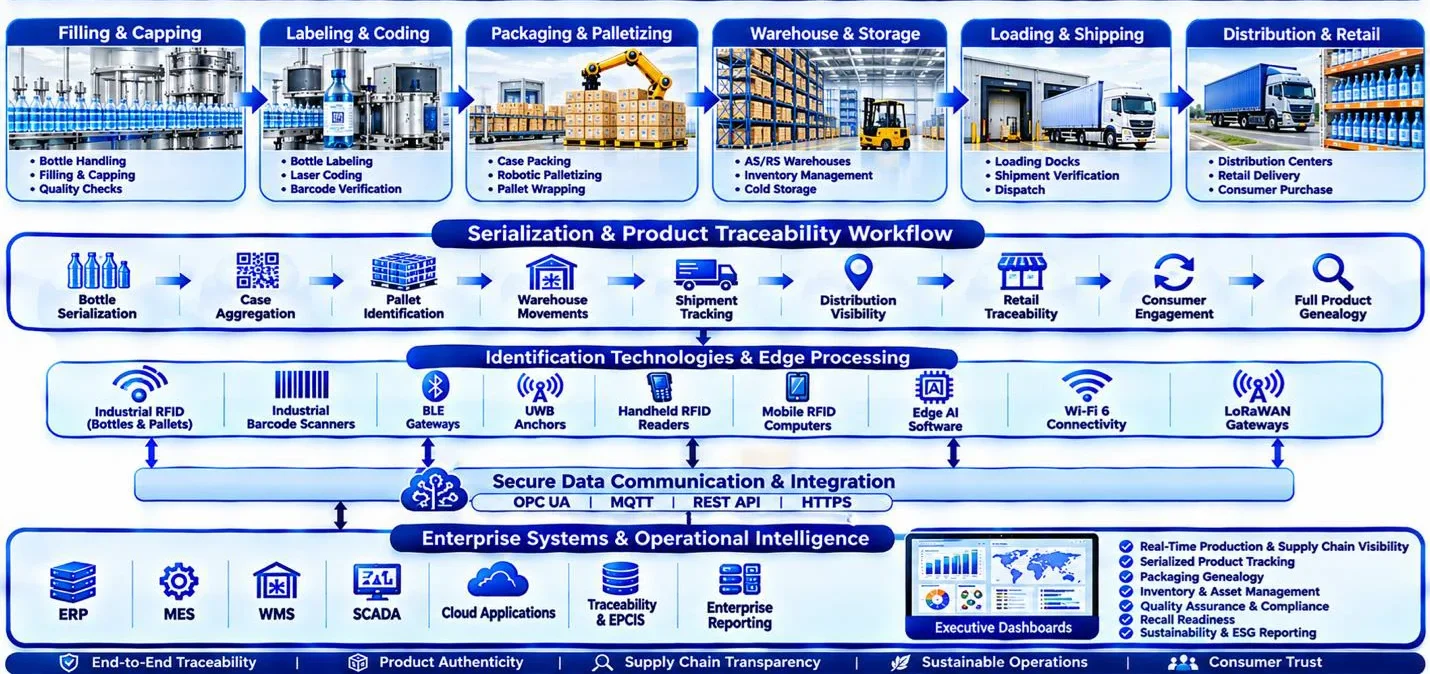
Beverage Bottle Serialization, Packaging Genealogy & End-to-End Product Traceability
This workflow diagram illustrates the complete lifecycle of serialized beverage bottles from filling, labeling, and laser coding through case packing, palletization, warehousing, shipping, distribution, and retail delivery. It shows RFID, barcode scanning, BLE, UWB, Wi-Fi, LoRaWAN, handheld readers, and Edge AI software capturing identification events that integrate with ERP, MES, WMS, SCADA, and enterprise dashboards through OPC UA and MQTT. The architecture enables bottle serialization, packaging genealogy, pallet traceability, shipment verification, and end-to-end product visibility across the beverage supply chain.
Operational Challenges Solved by AI and IoT
Packaging & Bottling Operations face operational challenges that directly affect production efficiency, warehouse productivity, customer service, and regulatory compliance.
Common operational challenges include:
- Misplaced packaging materials
- Missing returnable plastic crates
- Lost pallets
- Inaccurate warehouse inventory
- Delayed production replenishment
- Excessive forklift travel
- Packaging line bottlenecks
- Incorrect product labeling
- Mixed pallet errors
- Shipment loading mistakes
- Limited work-in-progress visibility
- Incomplete bottle serialization
- Fragmented production genealogy
- Manual inventory reconciliation
- Difficult recall investigations
- Administrative documentation workload
- Inconsistent reporting across multiple facilities
AI and IoT addresses these challenges by automating identification throughout manufacturing and logistics, replacing manual data collection with reliable digital records that improve operational accuracy and decision-making.
Why Food & Beverage Manufacturers Choose PackBottle AI
PackBottle AI specializes in enterprise AI and IoT identification and location solutions designed specifically for Packaging & Bottling Operations within the Food & Beverage Manufacturing Industry.
Created within Aperture Venture Studio with support from GAO, PackBottle AI leverages more than two decades of industrial IoT expertise gained through thousands of successful deployments across manufacturing, logistics, warehousing, and industrial automation environments.
The organization has made significant investments in research and development, engineering validation, and quality assurance, enabling customers to deploy reliable identification solutions that integrate effectively with existing manufacturing operations.
PackBottle AI is supported by multidisciplinary engineering teams led by Ph.D. professionals from leading universities, complemented by strategic technology partners and experienced implementation specialists with expertise in RFID, BLE, UWB, industrial barcode technologies, enterprise software integration, wireless communications, and industrial automation.
The underlying experience supporting PackBottle AI includes projects for Fortune 500 manufacturers, internationally recognized research institutions, leading universities, and U.S. and Canadian government agencies. This practical experience enables customers to implement scalable AI and IoT solutions that support operational excellence while minimizing deployment risk.
Future Trends in Packaging & Bottling Operations
Packaging & Bottling Operations continue to evolve toward increasingly connected manufacturing environments where digital identification, automated traceability, and intelligent production coordination become standard operational capabilities.
Several industry trends are accelerating this transformation, including:
- Expanded adoption of RFID-enabled returnable transport items
- Increased use of UWB for precise indoor asset positioning
- Greater deployment of Edge AI for localized operational decision support
- Broader implementation of digital product passports
- More comprehensive bottle and case serialization
- Higher levels of warehouse automation
- Standardized enterprise traceability frameworks
- Increased interoperability between production and logistics software
- Enhanced supply chain visibility across manufacturing and distribution
- Continued adoption of AI-assisted production analytics
As these technologies mature, manufacturers will be able to improve operational efficiency, simplify regulatory compliance, strengthen product authenticity, and enhance customer service while maintaining complete production genealogy from packaging materials through final product delivery.
Advancing Packaging & Bottling Operations Through AI and IoT
Packaging & Bottling Operations require continuous visibility across beverage filling, bottle handling, aluminum canning, labeling, cartoning, palletizing, warehousing, refrigerated storage, and distribution. Accurate identification of products, packaging materials, mobile assets, inventory, personnel, and finished shipments is fundamental to maintaining production efficiency, product quality, food safety, and regulatory compliance.
AI and IoT combines AI with industrial identification and location technologies including RFID, BLE, UWB, industrial barcode systems, Wi-Fi, LoRaWAN, GPS, cellular communications, OPC UA, MQTT, and Edge AI to create a comprehensive digital record of manufacturing and logistics activities.
Rather than replacing existing ERP, MES, WMS, SCADA, QMS, or CMMS software, AI and IoT complements these systems by providing accurate identification data that improves inventory visibility, packaging genealogy, bottle serialization, warehouse operations, pallet traceability, returnable asset management, and enterprise reporting.
Organizations implementing standardized identification strategies across Packaging & Bottling Operations are better positioned to improve operational efficiency, optimize resource utilization, simplify regulatory reporting, strengthen recall readiness, and support sustainable growth throughout the Food & Beverage Manufacturing Industry.
Contact PackBottle AI
Whether your organization operates bottled water facilities, carbonated beverage plants, brewery packaging lines, dairy beverage production, juice bottling operations, aluminum canning facilities, contract beverage manufacturing, refrigerated warehouses, or regional beverage distribution centers, PackBottle AI can help you implement enterprise AI and IoT identification solutions tailored to your operational requirements.
Our engineering specialists work closely with manufacturers to evaluate production workflows, identify operational improvement opportunities, recommend appropriate RFID, BLE, UWB, industrial barcode, Wi-Fi, LoRaWAN, GPS, OPC UA, MQTT, and Edge AI technologies, and integrate these solutions with existing ERP, MES, WMS, SCADA, QMS, and CMMS software.
Modernize Packaging & Bottling Operations with Enterprise AI and IoT Applications
Contact PackBottle AI to discuss your Packaging & Bottling Operations objectives and discover how enterprise-grade AI and IoT identification and location solutions can improve workforce coordination, hygienic access compliance, packaging asset utilization, inventory accuracy, work-in-progress visibility, bottle serialization, packaging genealogy, cold chain traceability, warehouse efficiency, outbound logistics, and multi-site operational performance.